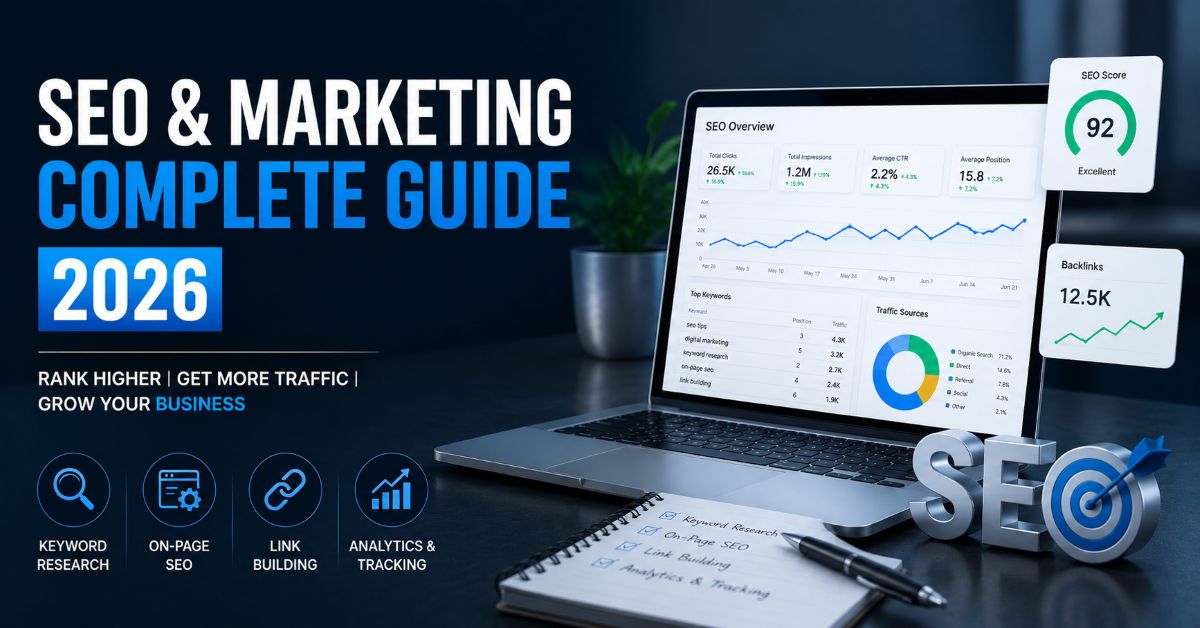
What Is Search optimizationg — And Why It Is the Most Valuable Long-Term Investment Any Business Can Make Online
Every day, Google processes over 8.5 billion search queries. People search for products to buy, services to hire, answers to questions, businesses near them, and solutions to problems they have never admitted to another person. The businesses that appear at the top of those results — consistently, across hundreds of relevant queries — are not there by accident. They are there because of organic marketingg: the discipline of making websites more visible, more authoritative, and more useful in the eyes of search engines and the humans who use them.
SEO marketing stands for Search Engine Optimization marketing — the systematic practice of improving a website’s organic (unpaid) visibility in search engine results pages (SERPs) to attract qualified traffic, build brand authority, and generate sustainable business growth without paying for every click. Unlike paid advertising, where visibility disappears the moment budget runs out, seo marketing compounds over time: every piece of optimized content, every high-quality backlink, and every technical improvement builds on previous work to create an asset that produces traffic and leads continuously.
The numbers behind seo marketing are compelling. Organic search is responsible for approximately 53% of all website traffic, according to industry research from BrightEdge. The first position in Google organic results receives an average click-through rate of 27.6%, according to Backlinko analysis. And businesses that invest consistently in seo marketing over 12–24 months consistently reduce their cost per lead compared to paid alternatives — because organic traffic, once established, costs the same whether it delivers 100 visitors or 100,000.
This complete guide covers everything you need to understand, implement, and measure seo marketing effectively in 2026: how search engines actually work, the three pillars of optimization that determine ranking success, how to build an seo strategy from scratch, what a proper seo audit involves, and how seo marketing creates compounding value that separates growing businesses from stagnant ones.
| SEO Marketing Component | What It Covers | Impact Level | Time to See Results |
|---|---|---|---|
| Technical SEO | Site speed, crawlability, structure, mobile optimization | 🔥 Foundation — High | Weeks (fixes applied) |
| On-Page SEO | Content, keywords, headings, meta tags, internal links | 🔥 Critical — High | 1–4 months |
| Off-Page SEO / Link Building | Backlinks, authority signals, brand mentions | 🔥 Authority — Very High | 3–12 months |
| Keyword Research | Target query identification, intent analysis, mapping | ✅ Strategic — Essential | Ongoing |
| Content Marketing (SEO-led) | Blog posts, guides, landing pages targeting specific queries | 🔥 Traffic — High | 3–8 months per piece |
| SEO Audit | Technical, content, and backlink analysis | ✅ Diagnostic — Essential | Immediate insight |
How Search Engines Work: The Foundation Every SEO Marketing Strategy Needs
Effective success requires understanding what you are actually optimizing for. Google and other search engines operate through three core processes: crawling, indexing, and ranking. Each stage creates opportunities for optimization intervention — and failures at any stage prevent your website from reaching its full organic potential.
Crawling: How Google Discovers Your Content
Search engines use automated programs called spiders or crawlers (Google’s is called Googlebot) to discover web pages by following links across the internet. Googlebot starts from a list of known URLs, visits those pages, extracts their content, and follows the links it finds to discover new pages. Your seo marketing strategy must ensure that Googlebot can efficiently crawl your entire website — blocked pages, broken internal links, and slow load times all reduce crawl efficiency and limit how much of your content Google can discover and evaluate.
According to Google’s official SEO Starter Guide, helping Google find your content through clear site architecture and an up-to-date XML sitemap is one of the most fundamental and immediately actionable this steps any website owner can take.
Indexing: How Google Stores and Understands Your Content
After crawling a page, Google analyzes its content — text, images, video, structured data — and stores this information in its index, a massive database of web pages that its ranking algorithms can query in milliseconds when a user performs a search. Effective optimization ensures that your pages are not just crawlable but indexable: no “noindex” tags incorrectly applied, no thin or duplicate content that Google might choose not to index, and clear canonical signals that tell Google which version of a page represents the authoritative source.
Ranking: How Google Decides Which Pages Appear Where
When a user performs a search, Google’s algorithm evaluates hundreds of ranking factors simultaneously to determine which pages are most relevant and authoritative for that specific query — and in what order to display them. The core elements of seo marketing directly influence these ranking factors: on-page relevance signals (keyword targeting, content quality, user experience), off-page authority signals (backlinks from reputable sources), and technical signals (page speed, Core Web Vitals, mobile optimization, structured data).
The Three Pillars of SEO Marketing: Technical, On-Page, and Off-Page
All optimization activity falls into one of three interconnected pillars. Understanding each pillar’s function helps businesses prioritize their the investments based on their current situation and highest-impact opportunities.
Pillar 1: Technical SEO Marketing — The Infrastructure That Everything Else Depends On
Technical seo marketing addresses the infrastructure of your website — the factors that determine whether search engines can efficiently crawl, index, and understand your content. No amount of excellent content or high-quality backlinks will overcome fundamental technical seo problems that prevent Google from properly processing your website.
The core elements of technical seo marketing in 2026:
- Page speed and Core Web Vitals: Google uses Core Web Vitals — Largest Contentful Paint (LCP), Interaction to Next Paint (INP), and Cumulative Layout Shift (CLS) — as ranking factors that directly measure user experience. Technical seo marketing that improves these scores signals to Google that your website delivers a quality experience worth ranking.
- Mobile optimization: Google uses mobile-first indexing — meaning it primarily uses the mobile version of your site for indexing and ranking. A website that delivers a poor mobile experience is at a significant technical seo disadvantage regardless of its desktop quality.
- Site architecture and internal linking: Clear URL structure, logical page hierarchy, and strategic internal linking allow search engines to understand the relationship between your pages and distribute ranking authority efficiently throughout your site.
- HTTPS and security: Google considers HTTPS a ranking signal and security best practice. Any seo marketing strategy for a site still running HTTP is incomplete without migration planning.
- Structured data (Schema markup): Structured data tells Google specifically what your content is — a product, a review, an event, a recipe, a FAQ — enabling rich results that increase click-through rates and visibility beyond standard blue links.
- XML sitemaps: A properly maintained sitemap helps Google discover and prioritize all indexable pages on your website, particularly important for large sites where Googlebot’s crawl budget limits how many pages it visits per day.
Pillar 2: On-Page SEO Marketing — Relevance Signals Within Your Control
On-page seo marketing involves everything within your direct control on individual web pages: the content itself, keyword targeting, heading structure, meta tags, image optimization, and internal linking. On-page search optimizationg is where keyword research meets content strategy — transforming target queries into pages that satisfy search intent better than competing results.
The essential elements of on-page seo marketing:
- Keyword targeting and search intent alignment: Every page in an the program should target specific queries and satisfy the intent behind them. Search intent falls into four categories — informational (how does X work), navigational (find a specific website), commercial (best X for Y), and transactional (buy X) — and content must match the intent Google associates with the target keyword.
- Title tag optimization: The HTML title tag is the single most important on-page seo marketing element — it appears as the clickable headline in search results and signals to Google the primary topic of the page. Effective title tags place target keywords toward the beginning, remain within 55-60 characters to avoid truncation in SERPs, and include compelling language that drives clicks above competing results.
- Meta description: While not a direct ranking factor, the meta description appears below the title in search results and significantly affects click-through rate — a behavioral signal that indirectly influences organic performance. Compelling meta descriptions (156-160 characters) that accurately preview the page’s value drive higher CTR from equivalent ranking positions.
- Heading structure (H1–H6): Proper heading hierarchy helps both search engines and users understand the structure and hierarchy of content. Each page should have exactly one H1 containing the primary keyword, with H2s covering major topics and H3s providing supporting detail — a structure that on-page seo marketing enforces across all website content.
- Content quality and depth: Google’s algorithm increasingly rewards genuinely useful, comprehensive, expert-authored content — and penalizes thin, generic content that provides no unique value. SEO copywriting that addresses real user questions with real expertise is at the core of modern on-page seo marketing.
- Image optimization: Every image presents an on-page seo marketing opportunity: descriptive file names (not “image001.jpg”), alt text that describes image content for screen readers and search engines, proper file compression for performance, and where appropriate, caption text.
Pillar 3: Off-Page SEO Marketing — Authority Signals Beyond Your Website
Off-page seo marketing builds the external authority signals that tell Google your website is trusted, relevant, and worth ranking highly. The primary off-page search optimizationg signal is backlinks — links from other websites pointing to yours — which function as votes of confidence that Google’s algorithm uses to assess domain authority.
Not all backlinks are equal in optimization terms. A single link from a high-authority, relevant website (a major publication in your industry, a university, a government agency) carries far more seo marketing weight than hundreds of links from low-quality, irrelevant, or artificially generated sources. Modern link building in seo marketing is about earning genuinely valuable backlinks through content excellence, digital PR, strategic outreach, and creating resources that other websites naturally want to reference.
Keyword Research: The Strategic Core of SEO Marketing
Every effective the program begins with keyword research — the systematic process of identifying the specific search queries your target audience uses, understanding the intent behind those queries, evaluating the competition for ranking opportunities, and mapping keywords to specific pages in your website architecture.
Understanding Search Volume and Keyword Competition
SEO keyword analysis involves evaluating each potential target keyword across three dimensions: search volume (how many people search for this query monthly), keyword difficulty (how competitive ranking for this query is relative to your domain authority), and commercial value (how directly this query connects to business outcomes).
High-volume keywords are not always the best seo marketing targets — extremely competitive queries often require years of authority building before a newer or smaller domain can compete. The most effective optimization keyword strategies identify the intersection of relevance, achievable ranking opportunity, and business value: keywords where your content can realistically rank within a reasonable timeframe while still attracting the audience that produces business results.
Long-Tail Keywords in SEO Marketing
Long-tail keywords — longer, more specific phrases with lower search volume but higher intent specificity — represent some of the highest-value seo marketing opportunities, particularly for newer domains. A query like “search optimizationg for small business owners 2026” may receive 200 monthly searches compared to 50,000 for “organic marketingg,” but it converts at dramatically higher rates because the searcher’s intent is specific and their purchase intent may be strong. An search engine optimizationg strategy that targets hundreds of relevant long-tail keywords alongside primary volume targets builds both traffic scale and conversion quality.
Keyword Mapping and Search Intent
Keyword mapping — assigning target keywords to specific pages in your website — prevents the this problem of keyword cannibalization (multiple pages competing for the same query) and ensures that every page has a clear, distinct purpose in the overall seo marketing architecture. A properly mapped seo marketing keyword strategy means that when Google encounters your website, each page has a distinct informational role, a clear primary keyword target, and content specifically designed to satisfy the intent associated with that target query.
The SEO Audit: Your SEO Marketing Starting Point
Before building or rebuilding an seo marketing strategy, a comprehensive seo audit identifies what is working, what is broken, and where the highest-impact opportunities lie. An seo audit is the diagnostic foundation of any professional the program — without it, optimization efforts are guesswork rather than targeted interventions.
What a Comprehensive SEO Audit Covers
A professional seo audit for optimization purposes evaluates three interconnected areas:
- Technical seo audit: Crawl analysis identifying broken pages (404 errors), redirect chains, slow-loading pages, mobile usability issues, duplicate content problems, indexation errors, and Core Web Vitals performance. Tools like Google Search Console, Screaming Frog, and Ahrefs Site Audit automate much of this technical seo marketing diagnostic work.
- Content and on-page seo audit: Evaluation of existing content quality, keyword alignment, missing meta tags, thin content, pages targeting the wrong intent, and internal linking gaps. This portion of the seo audit reveals which existing pages can be optimized for quick ranking improvements versus which need to be rewritten or consolidated.
- Backlink profile audit: Analysis of existing linking domains for quality, relevance, anchor text distribution, and potentially toxic links that could be suppressing organic organic performance. Understanding your current backlink profile is essential for setting realistic seo strategy timelines and identifying link building priorities.
For businesses beginning an the program, Moz’s Beginner’s Guide to SEO and the Wikipedia overview of search engine optimization provide valuable foundational context that complements a professional technical seo audit.
SEO Marketing for Small Business: How Smaller Organizations Can Compete Effectively
One of the most persistent misconceptions about seo marketing is that it favors large brands with enormous budgets and established domain authority — making it inaccessible or impractical for small businesses. The reality is more nuanced, and often more favorable to small businesses than they realize.
Local SEO Marketing: Small Business’s Most Powerful Opportunity
Local seo marketing — optimizing for location-specific search queries like “seo agency near me” or “digital marketing services [city name]” — levels the competitive playing field dramatically. Google’s local search algorithm gives significant weight to proximity, relevance, and prominence for local queries, meaning a well-optimized local business can outrank major national competitors for location-specific searches that represent the most commercially valuable traffic in their market.
The foundation of local seo marketing is a fully optimized Google Business Profile — which remains the single highest-ROI this action for any business serving customers in a specific geographic area. Consistent NAP (Name, Address, Phone) information across all online directories, genuine customer reviews, and location-specific website content complete the core local the infrastructure.
Content-Led SEO Marketing for Small Businesses
Small businesses can compete effectively in organic seo marketing by targeting the informational and long-tail queries that larger competitors overlook. A comprehensive blog article answering specific questions in your niche — with genuine expertise, real data, and human insight that generic content farms cannot provide — regularly outranks content from larger domains because Google’s algorithm rewards topical relevance and content quality, not just domain authority.
The this approach that consistently works for small businesses: identify the specific questions your ideal customers ask before they are ready to buy, create the definitive answer to those questions, and build the authority that comes from consistently being the most helpful resource in your space. This content-led seo marketing strategy creates a compounding traffic asset that grows with every additional piece of published content.
Building Your SEO Strategy: A Step-by-Step Framework for 2026
A successful seo strategy is not a list of tactics — it is a coherent, prioritized plan that connects your business goals to specific ranking opportunities to measurable organic growth outcomes. Here is the practical framework for building an seo strategy that produces compounding results.
Step 1: Establish Your Baseline with an SEO Audit
Before investing in new optimization activities, understand your current position. Run a technical seo audit to identify crawlability and indexation issues. Review your Google Search Console data to understand which queries already drive impressions and clicks. Analyze your backlink profile to understand your current domain authority. This baseline assessment ensures your seo strategy invests in the highest-impact improvements rather than building on a broken foundation.
Step 2: Conduct Comprehensive Keyword Research
Using keyword research tools (Google Keyword Planner, Ahrefs, SEMrush), identify the full landscape of relevant queries your audience uses. Organize keywords by intent (informational, commercial, transactional), evaluate difficulty relative to your current authority, and identify the highest-priority opportunities — typically high-relevance, achievable-difficulty queries with meaningful search volume that connect to your business outcomes.
Step 3: Audit and Optimize Existing Content
Before creating new content, maximize the seo marketing value of what already exists. Identify pages with ranking potential that are not fully optimized — improve title tags, expand thin content, add internal links, fix on-page seo gaps. Many websites achieve their fastest quick wins through content optimization of existing pages rather than new content creation.
Step 4: Build a Content Production Calendar
Map priority target keywords to specific content pieces. For each content piece, define the primary keyword, the intent it serves, the format that best satisfies that intent (comprehensive guide, listicle, comparison, FAQ, video), and the publication date. Consistent content production is the engine of long-term seo marketing growth — it compounds over time as each piece builds the topical authority that makes future content rank faster.
Step 5: Execute Link Building Systematically
A link building strategy for seo marketing identifies the types of backlinks most relevant and achievable for your website, and creates a systematic approach to earning them. Common link building approaches in professional optimization include: guest posting on relevant publications, creating linkable assets (original research, tools, comprehensive guides), digital PR for newsworthy brand stories, and relationship building with industry publishers and bloggers.
Step 6: Measure, Report, and Iterate
Seo marketing produces its best results when performance data drives continuous improvement. Monthly tracking of organic traffic, keyword rankings (for target queries), conversion rate from organic traffic, and backlink acquisition rate reveals what is working and what needs adjustment. Google Search Console provides free, authoritative data on impressions, clicks, average position, and Core Web Vitals that should form the foundation of any SEO reporting framework.
Website Ranking Factors: What Actually Moves the Needle in 2026
Google’s ranking algorithm is reported to consider over 200 factors when determining website ranking for any given query. Most of these factors are refinements of the core principles — relevance and authority — rather than fundamentally independent signals. Understanding the website ranking factors that have the most measurable impact in 2026 helps prioritize the investment effectively.
Top Website Ranking Factors in 2026
| Website Ranking Factor | Category | 2026 Importance | SEO Marketing Action |
|---|---|---|---|
| Content relevance and quality | On-page | 🔥 Critical | Target keyword intent precisely; write expert-quality content |
| Backlink quality and authority | Off-page | 🔥 Critical | Earn links from authoritative, topically relevant sources |
| Core Web Vitals | Technical | 🔥 High | Improve LCP, INP, and CLS scores across all pages |
| Mobile optimization | Technical | 🔥 High | Mobile-first design; test all pages on mobile devices |
| E-E-A-T signals | Content/Authority | 🔥 Critical | Demonstrate experience, expertise, authoritativeness, trustworthiness |
| Internal linking structure | Technical/On-page | ✅ High | Strategic internal links distribute authority and signal topic relationships |
| User experience signals | Behavioral | ✅ High | Improve dwell time, reduce bounce rate through content quality |
| Structured data | Technical | ✅ Medium-High | Implement relevant schema markup for rich results eligibility |
SEO Marketing vs. Paid Search: Understanding the Difference and When to Use Each
A question that arises in virtually every this conversation is how organic seo marketing compares to paid search advertising (PPC/Google Ads), and how to allocate budget between the two. Understanding the fundamental differences helps businesses make strategic decisions rather than arbitrary ones.
Organic SEO Marketing vs. Paid Search: Key Differences
Organic seo marketing and paid search target the same Google search results pages but operate on entirely different economic models. Paid search delivers immediate visibility for targeted queries by purchasing ad placements in the sponsored results above organic listings — but the moment budget stops, visibility stops. Organic success requires significant upfront investment (time, content, technical work, link building) with delayed returns — but once established, organic rankings persist without per-click cost, creating a progressively more efficient traffic source over time.
The seo marketing advantage compounds over years: the cost per organic visitor typically decreases as ranking authority increases, while paid search costs generally increase year over year as more advertisers compete for the same queries. Businesses with established the programs routinely generate organic traffic at a fraction of the per-visitor cost of equivalent paid traffic.
Most sophisticated digital marketing programs treat organic seo marketing and paid search as complementary channels rather than alternatives: paid search delivers immediate traffic and lead generation while seo marketing builds the long-term organic foundation that reduces paid advertising dependency over time.
How Long Does SEO Marketing Take to Show Results?
This is the most common question asked of every seo marketing professional — and one of the most important to answer honestly, because unrealistic expectations lead to premature abandonment of the programs that were on track to deliver significant value.
The honest timeline for seo marketing results depends on several variables:
- Domain age and existing authority: A five-year-old domain with existing backlinks and indexed content will see these improvements faster than a brand-new domain starting from zero.
- Competitive intensity: Ranking for “seo marketing tips” is easier than ranking for “seo services” — the commercial intent of the second query means every seo agency is competing aggressively for it.
- Technical baseline: A website with significant technical seo problems (slow speed, indexation errors, mobile issues) will see its first quick wins from fixing these foundations, sometimes within weeks.
- Content production rate: An the program publishing four high-quality, keyword-targeted pieces of content monthly will produce results significantly faster than one publishing one piece quarterly.
- Link building velocity: Domains actively earning high-quality backlinks see website ranking improvements faster than those relying on organic link acquisition alone.
A realistic general timeline for seo marketing results: technical improvements are visible in weeks, content optimization of existing pages shows ranking movement in 1–3 months, new content begins ranking in 3–6 months, and a comprehensive the program shows significant organic traffic growth in 6–12 months with compounding returns continuing for years beyond.
Measuring SEO Marketing Success: The Metrics That Matter
Seo marketing produces measurable, attributable business value — but only if you track the right metrics. Vanity metrics (raw keyword rankings without business context) tell a fraction of the story. The metrics that provide genuine organic performance insight are:
- Organic traffic (sessions and users): The foundational seo marketing volume metric — how many people are reaching your website through organic search, and how that number is trending over time.
- Keyword rankings for target queries: Tracking specific ranking positions for your priority keywords reveals whether seo marketing is producing the website ranking movements your strategy targets.
- Organic conversion rate: How effectively organic traffic converts into business outcomes (leads, sales, sign-ups). Seo marketing that generates high traffic but low conversion indicates either keyword intent mismatch or landing page optimization issues.
- Impressions and click-through rate (CTR): From Google Search Console, impressions show how often your pages appear in search results, and CTR measures how effectively your title tags and meta descriptions convert impressions into clicks — an often overlooked on-page seo marketing optimization lever.
- Domain authority and backlink growth: Tracking the growth of your backlink profile (number of linking domains, domain authority score) measures the off-page the foundation being built.
- Core Web Vitals scores: Technical technical health metrics that correlate directly with both Google ranking potential and user experience quality.
Common SEO Marketing Mistakes That Undermine Results
- Targeting keywords without understanding search intent: Creating content about “seo marketing” when searchers for that query want a conceptual overview, then targeting it at a sales page, produces content that satisfies neither the user nor Google’s intent-matching algorithm.
- Ignoring technical seo fundamentals: Excellent content on a technically broken website produces minimal seo marketing results. Slow page speed, mobile usability errors, and indexation problems are not optional to fix before other this work can succeed.
- Publishing thin, derivative content: Content that paraphrases existing information without adding original insight, expert perspective, or genuine value does not earn the organic rankings that well-researched, genuinely helpful content consistently achieves in the programs.
- Pursuing low-quality backlinks: Link building shortcuts — paid link schemes, private blog networks, irrelevant directory submissions — produce short-term gains that Google’s algorithm progressively devalues, and in severe cases, manual penalties that can devastate organic organic performance.
- Abandoning seo marketing too early: The most common and most costly seo marketing mistake is stopping the program at month 3 or 4 because results are not yet visible — exactly when the compounding effects of consistent optimization are beginning to build toward the ranking breakthroughs that come in months 6–12.
- Neglecting website ranking monitoring: Seo marketing without tracking is operating blind. Regular monitoring of keyword rankings, organic traffic trends, and technical health through Google Search Console is the minimum measurement infrastructure any the program requires.
Frequently Asked Questions About SEO Marketing
What is seo marketing and how does it work?
Search optimizationg (Search Engine Optimization marketing) is the practice of improving a website’s organic visibility in search engine results through technical optimization, content development, and authority building (link acquisition). It works by aligning your website’s content, structure, and external signals with the factors Google’s algorithm uses to evaluate relevance and authority — resulting in higher organic rankings for target queries, which drives qualified traffic without per-click advertising cost.
How much does seo marketing cost?
SEO marketing costs vary significantly by scope, competition level, and whether you execute in-house or with professional support. Small business search optimizationg typically costs $500–$2,000 per month for professional support covering technical optimization, content, and link building. Mid-market businesses invest $2,000–$8,000 monthly. Enterprise the programs in highly competitive verticals can exceed $20,000 per month. The appropriate investment depends on your competitive landscape, revenue potential from organic traffic, and the gap between current performance and target outcomes.
What is the difference between on-page and off-page seo marketing?
On-page seo marketing refers to all optimization factors within your direct control on your own website: content quality, keyword targeting, title tags, meta descriptions, heading structure, internal linking, and technical performance. Off-page search optimizationg refers to authority signals that originate from other websites: primarily backlinks from external domains, but also brand mentions, social signals, and digital PR coverage. Both pillars are necessary for comprehensive optimization success — on-page relevance signals tell Google what your content is about, while off-page authority signals tell Google that your content is trustworthy and worth ranking highly.
How do I know if my seo marketing is working?
The primary indicators of seo marketing progress are: increases in organic traffic (Google Analytics), improvements in keyword rankings for target queries (tracked via Search Console or rank tracking tools), growth in the number of backlinks and referring domains (Ahrefs, SEMrush, or Google Search Console), and improvements in Core Web Vitals scores. Lead generation and revenue attributable to organic search are the ultimate search optimizationg success metrics — connecting ranking improvements to business outcomes.
What is an seo audit and why is it important?
An seo audit is a comprehensive analysis of your website’s technical infrastructure, content quality, and backlink profile to identify issues preventing optimal ranking and opportunities for improvement. An seo audit is important because it establishes the diagnostic baseline for any the program — revealing whether technical problems are suppressing existing content quality, which pages have the most immediate ranking potential, and where link building investment will produce the greatest authority gains. Without an seo audit, optimization efforts are untargeted and often miss the highest-impact opportunities.
Is seo marketing still worth it in 2026?
Yes — seo marketing remains one of the highest long-term ROI marketing investments available. While Google’s AI Overviews have reduced click-through rates for some informational queries, organic search still drives approximately 53% of all website traffic and produces significantly lower cost-per-lead compared to paid alternatives for businesses with established organic presence. The key adaptation for 2026 search optimizationg is producing content with genuine expertise and original insight that AI systems recognize as authoritative enough to cite — which simultaneously satisfies Google’s E-E-A-T requirements and serves real user needs better than thin content.
Conclusion: SEO Marketing Is a Long-Term Investment That Pays Compounding Returns
The businesses winning at organic seo marketing in 2026 are not those who started with the largest budgets or the most sophisticated tools. They are the ones who committed to the fundamentals — technically sound websites, genuinely useful content, and legitimate authority building — and maintained that commitment long enough for compounding effects to produce measurable competitive advantage.
Success requires patience that paid advertising does not. But it also produces something paid advertising never can: an owned asset that generates qualified traffic continuously, at diminishing marginal cost, across a growing portfolio of ranking keywords that represent every stage of your customer’s decision journey. Every blog post that earns a first-page ranking, every backlink that increases your domain authority, and every technical improvement that helps Google more efficiently crawl your site contributes to a compounding organic presence that becomes progressively harder for competitors to replicate.
Whether you are beginning your first the program, auditing an existing one that has not produced expected results, or looking to scale an organic search strategy that is already generating momentum, the principles in this guide provide the framework. Start with a comprehensive seo audit. Build a keyword strategy grounded in genuine search intent research. Produce content that deserves to rank. Earn the backlinks that establish authority. Measure everything. And maintain the consistency that transforms good organic strategy into compounding organic growth.
For expert expert support that applies these principles to your specific business and competitive landscape, explore our SEO services, read our complete digital marketing guide for the broader strategic context, and visit our marketing blog for ongoing expert insights and 2026 algorithm updates.


Subscribe to receive in-depth reviews, honest comparisons, and practical recommendations that help you choose the right products with confidence.
Newsletter coming soonNo spam. No hype. Just clear, helpful insights.