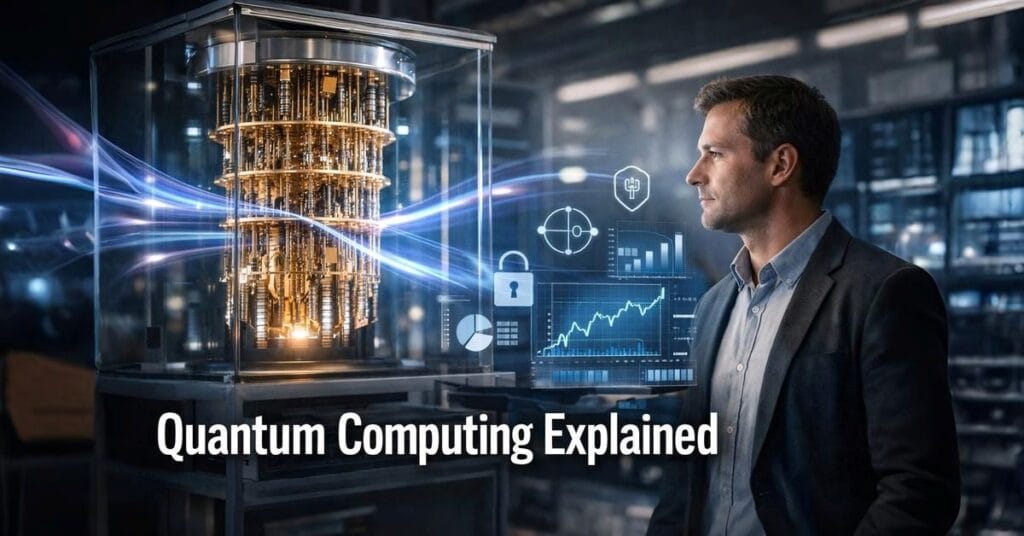
Introduction: 2026 Is the Year Quantum Computing Stops Being Theoretical
Until recently, quantum computing explained in mainstream publications felt like science fiction wrapped in physics equations — impressive, distant, and largely irrelevant to anyone outside a research laboratory. That changed in 2026. The global quantum computing market has crossed the $10 billion threshold, Google’s Willow chip has demonstrated an algorithm running 13,000 times faster than the world’s best classical supercomputers, IBM is on track to deliver verified quantum advantage before year’s end, and Microsoft’s Majorana 1 processor — using novel topological qubits — has moved practical quantum computing from decades away to potentially years away.
More importantly, the implications of these breakthroughs have left the physics department and landed directly in cybersecurity strategy sessions, financial risk assessments, pharmaceutical R&D pipelines, and national security briefings. The way quantum computing explained to boards and executive teams in 2026 is no longer “here is an emerging technology to monitor” — it is “here is a technology that will crack your current encryption, transform your drug discovery process, and restructure competitive advantages across industries within a defined timeline.”
This comprehensive guide provides quantum computing explained clearly and completely — from the foundational physics that makes it fundamentally different from classical computing, through the 2026 hardware race between IBM, Google, and Microsoft, to the industry-specific applications, cybersecurity threats, and practical actions that businesses and individuals should be taking today.
What this complete guide covers:
- Quantum computing explained from first principles through 2026 breakthroughs
- How qubits, superposition, entanglement, and quantum interference actually work
- IBM, Google, and Microsoft: three competing hardware approaches compared
- Quantum advantage: what it means and why 2026 is the inflection point
- Applications across cryptography, finance, drug discovery, AI, and logistics
- The quantum threat to current encryption — and the post-quantum defense
- The $10B+ market landscape and 10-year growth trajectory
- What businesses and individuals should actually do with this information now
| Company | Approach | 2026 Milestone | Qubit Count | Key Advantage |
|---|---|---|---|---|
| IBM | Superconducting qubits | Nighthawk: 120-qubit, verified advantage target | 1,000+ (Condor) | Cloud access, enterprise integration |
| Superconducting + error correction | Willow: 105 qubits, 13,000x speedup | 105 (Willow) | Error correction leadership | |
| Microsoft | Topological qubits | Majorana 1: first topological processor | Early stage | Inherently lower error rates |
| IonQ | Trapped ions | High-fidelity algorithmic qubits | 36 AQ | Highest gate fidelity |
| PsiQuantum | Photonic qubits | $1.3B+ funded, silicon photonics path | Research stage | Room-temperature operation potential |
Quantum Computing Explained: The Core Concept
To understand quantum computing explained properly, and to, you need to understand what makes it fundamentally different from classical computing — not just faster, but architecturally different in the type of problems it can solve.
With quantum computing explained, the contrast to classical systems becomes clear. Classical computers — every laptop, smartphone, server, and supercomputer in existence today — process information using bits. Each bit is a transistor that exists in one of two states: 0 or 1. All computation reduces to sequences of these binary operations. To solve a problem with one million possible configurations, a classical computer must evaluate them sequentially (or in limited parallel batches), one at a time.
According to Wikipedia’s comprehensive overview of quantum computing, a quantum computer processes information using quantum bits — qubits — that can exist in multiple states simultaneously through a property called superposition. When you add entanglement (qubits becoming correlated regardless of physical distance) and interference (using quantum wave behavior to amplify correct answers and cancel incorrect ones), the result is a computational architecture that can explore enormous solution spaces simultaneously rather than sequentially.
The practical implication — quantum computing explained through this lens —: a 300-qubit quantum computer can theoretically represent more states simultaneously than there are atoms in the observable universe. This is not just “faster computing” — it is computing that can approach problem classes that are fundamentally intractable for classical systems regardless of how much hardware you add or how long you wait.
What Quantum Computing Is Not
Quantum computing explained accurately requires equal clarity about what it is not:
- It is not a replacement for classical computers. Quantum systems excel at specific problem classes (optimization, simulation, cryptography, factoring) while classical computers remain superior for most everyday computational tasks.
- It is not infinitely fast. Quantum computers have overhead from error correction, state preparation, and measurement that makes them slower than classical computers for problems they are not architecturally suited to solve.
- It is not yet commercially available in the powerful form discussed in this guide. Current quantum computers are NISQ (Noisy Intermediate-Scale Quantum) devices with significant error rates that limit their practical applications — though this is changing rapidly in 2026.
- It is not ready to break encryption today. Current systems lack the error-corrected logical qubits required for cryptographic attacks — but the window of safety is narrowing significantly.
How Qubits Actually Work: Quantum Computing Explained Through Physics
Quantum computing explained at a deeper level requires understanding the three quantum mechanical phenomena that give qubits their extraordinary properties: superposition, entanglement, and interference. These are not metaphors or approximations — they are measurable physical phenomena that quantum computers harness as computational resources.
Superposition: Quantum Computing Explained Through State Simultaneity
A classical bit is either 0 or 1. A qubit in superposition can be described as a weighted combination of 0 and 1 simultaneously — not “sometimes 0 and sometimes 1” but genuinely occupying both states at once until measured. The mathematical description (a probability amplitude for each state) allows a quantum computer with n qubits to represent 2^n states simultaneously.
The practical implication: two qubits represent 4 states simultaneously; 10 qubits represent 1,024 states; 50 qubits represent over one quadrillion states. Quantum computing explained through this lens reveals why it can explore massive solution spaces in parallel — it is not running multiple calculations serially but genuinely processing the entire possibility space at once.
Entanglement: Quantum Computing Explained Through Qubit Correlation
Entanglement occurs when two qubits become correlated in such a way that the state of one instantaneously determines aspects of the other, regardless of the physical distance separating them. This is not faster-than-light communication — measuring the state of one entangled qubit immediately reveals information about its partner, but this cannot transmit information.
In quantum computing, entanglement serves as a resource that allows operations on one qubit to effectively operate on correlated qubits simultaneously, enabling coordination across the quantum register that has no classical analog. Quantum computing explained without addressing entanglement misses one of the key reasons quantum computers can solve certain problems so much more efficiently than classical systems.
Interference: Quantum Computing Explained Through Wave Amplification
Quantum interference is the mechanism that makes quantum algorithms work. After superposition creates all possible solution states, and entanglement correlates them, quantum algorithms apply operations that constructively interfere (amplify) the probability amplitudes of correct answers while destructively interfering (canceling) incorrect ones. When the system is measured at the end of the computation, the most probable outcome observed is the correct answer.
This interference mechanism is what separates a quantum computer from a random guesser. Quantum computing explained through the interference lens reveals why quantum algorithms like Shor’s (for factoring) and Grover’s (for database search) produce reliable results despite the underlying probabilistic nature of quantum mechanics.
The 2026 Quantum Computing Landscape: Milestones That Make It Real
Understanding where quantum computing stands in 2026 requires separating genuine technical milestones from marketing claims. The field has advanced substantially, but honest assessment of what has been achieved — and what remains to be solved — is essential for making informed decisions.
Google’s Willow Chip: Quantum Computing Explained Through Real Milestones
Google’s 105-qubit Willow processor represents the most significant quantum computing development of early 2026. The Quantum Echoes algorithm demonstration showed a 13,000-fold speedup over classical supercomputers on a specific molecular simulation task that would have taken classical hardware approximately 10 septillion years. More importantly, Willow achieved “below threshold” error correction — the critical milestone where adding more qubits actually reduces the error rate rather than increasing it, resolving the central challenge that had limited quantum computing scalability for decades.
Google’s quantum AI research team published a white paper acknowledging that Willow’s capabilities represent an early warning signal for cryptographic infrastructure — current RSA and elliptic curve cryptography will be vulnerable to future quantum systems if organizations do not migrate to post-quantum cryptographic standards proactively.
IBM’s Roadmap: Verified Quantum Advantage by End of 2026
IBM’s quantum computing roadmap positions the company as the most enterprise-focused player in the market. The IBM Nighthawk 120-qubit processor achieved a 10x speedup in quantum error correction a year ahead of schedule, and IBM’s Condor processor has surpassed 1,000 physical qubits. The company’s cloud-based quantum computing access model — IBM Quantum — provides more than 200 organizations worldwide with access to quantum processing through standard API calls, accelerating the transition of quantum computing from research tool to enterprise service.
IBM’s long-term roadmap targets quantum circuits with up to 7,500 gates by 2026 and quantum-centric supercomputers with thousands of logical qubits capable of running 1 billion gates by 2033. The IBM-Cisco partnership further targets networked distributed quantum infrastructure by 2030, suggesting quantum computing architecture that parallels the distributed computing model that transformed classical IT in the 2000s.
Microsoft’s Topological Approach: Majorana 1
Microsoft’s Majorana 1 processor represents the most architecturally distinct approach to quantum computing among major players. Rather than superconducting qubits (IBM, Google) or trapped ions (IonQ), Majorana 1 uses topological qubits based on Majorana fermions — exotic quantum states that Microsoft claims offer inherently lower error rates because they store quantum information in a fundamentally more stable physical configuration.
While still in earlier development stages than IBM or Google’s systems, Microsoft’s topological approach has generated significant excitement because — if the error rate claims hold at scale — it could enable a dramatically shorter path to fault-tolerant quantum computing than error-correction-intensive approaches require. Microsoft has stated that Majorana 1 could enable practical quantum computers in “years, not decades.”
Quantum Advantage: The Threshold That Changes Everything
Quantum computing explained to business leaders invariably centers on the concept of quantum advantage — the moment when a quantum computer demonstrably outperforms the best classical computer for a commercially or scientifically meaningful task. This concept matters because it separates theoretical capability from practical relevance.
Quantum Advantage: Quantum Computing Explained at Its Peak
Quantum computing explained accurately must address what quantum advantage actually means. Not all quantum “speedups” qualify as quantum advantage. Early demonstrations showing quantum computers solving contrived problems designed to favor their architecture (like Google’s 2019 Sycamore demonstration with random circuit sampling) were scientifically significant but practically limited. True quantum advantage means a quantum system solving a problem that has meaningful real-world applications faster than any classical system — a much higher bar.
The 2026 milestones are approaching this higher bar. Google’s molecular simulation speedup has direct applications to drug discovery and materials science — researchers simulating molecular interactions to find drug candidates currently wait days or weeks for results that quantum systems could potentially provide in minutes. IBM’s optimization speedups have direct applications to logistics, financial portfolio optimization, and supply chain management.
The NISQ Era: Quantum Computing Explained in Its Current State
Quantum computing explained at its current state means NISQ era systems. Current quantum systems operate in the NISQ (Noisy Intermediate-Scale Quantum) era — computers with 10–1,000+ qubits but significant error rates that limit their practical applicability. NISQ devices can demonstrate quantum advantage on specific narrow problems but cannot yet sustain the complex computations needed for general-purpose quantum advantage.
Quantum computing explained through the fault-tolerance lens reveals the true development timeline. The transition from NISQ to fault-tolerant quantum computing — systems with error rates low enough to run arbitrarily complex algorithms reliably — is the critical inflection point. Most expert consensus places this transition in the 2028–2032 window, with the 2026 milestones representing meaningful progress toward it rather than its achievement.
Quantum Computing Applications by Industry: Where It Matters Most
Quantum computing explained in practical terms requires examining the specific problem classes where quantum systems provide genuine advantage, and which industries encounter those problem classes most frequently in their operations.
Cryptography and Cybersecurity
The most immediate and widely discussed application of quantum computing in the enterprise risk context is cryptographic vulnerability. Most current internet security — HTTPS, banking transactions, email encryption, VPNs, digital signatures — relies on RSA, Diffie-Hellman, and elliptic curve cryptography. These systems are secure against classical attacks because the mathematical operations they depend on (factoring large integers, computing discrete logarithms) are computationally infeasible for classical computers at the key sizes in use.
Quantum computing explained in the cryptography context centers on Shor’s algorithm — a quantum algorithm with no known efficient classical equivalent — can solve these factoring problems exponentially faster than any classical approach. A sufficiently large, fault-tolerant quantum computer running Shor’s algorithm would render all current public-key cryptography insecure. The NIST Post-Quantum Cryptography Standardization Program published its first four approved quantum-resistant cryptographic algorithms in 2024 and continues working toward complete standards — but migrating existing infrastructure to post-quantum standards requires years of effort that organizations should have begun or be planning now.
The “harvest now, decrypt later” threat is particularly concerning for organizations that handle sensitive long-term information. Adversaries are believed to be systematically capturing encrypted data today with the intention of decrypting it once sufficiently powerful quantum computers become available. Data with a 20-year sensitivity window is already at risk from this strategy. This aspect of quantum computing explained to security professionals changes risk timelines significantly — the threat is present, not future.
Pharmaceutical Drug Discovery: Quantum Computing Explained in the Lab
Quantum computing explained in a pharmaceutical context starts with molecular simulation. Drug discovery involves simulating molecular interactions at the quantum mechanical level — a task that is intractable for classical computers beyond very small molecules. Classical computers cannot accurately simulate the quantum behavior of large organic molecules, which is why drug discovery relies on approximations, physical laboratory experiments, and a 10–15 year development timeline with a failure rate above 90%.
Quantum computing’s natural ability to simulate quantum systems makes it inherently suited to molecular simulation. A sufficiently powerful quantum computer could simulate drug-target interactions, predict protein folding configurations, and model metabolic pathways at quantum accuracy — potentially compressing the drug discovery timeline from decades to years and dramatically increasing success rates by enabling accurate in-silico testing before costly physical trials. Pharmaceutical companies including Pfizer, Merck, and Roche have active quantum computing research partnerships specifically targeting this application.
Financial Services: Quantum Computing Explained for Portfolio Managers
Quantum computing explained for finance reveals why the sector has some of the highest potential ROI from the technology. Financial institutions use optimization algorithms extensively — for portfolio construction, risk management, fraud detection, option pricing, and Monte Carlo simulations. Many of these optimization problems involve searching enormous solution spaces (all possible portfolio allocations subject to constraints, for example) where quantum computing’s parallel evaluation capability provides genuine advantage over classical approaches.
JPMorgan Chase, Goldman Sachs, and Barclays have active quantum computing research programs. Specific applications under development include: Monte Carlo simulation acceleration for option pricing (where quantum speedup could reduce simulation time from hours to seconds), portfolio optimization across thousands of securities, and fraud detection pattern matching using quantum machine learning approaches. For organizations managing large investment portfolios, quantum computing explained in this context reveals a future competitive landscape where quantum-enabled institutions can construct more optimal portfolios faster than those relying on classical optimization.
The intersection of quantum computing and financial planning is explored in depth in our 2026 financial planning guide, which addresses how emerging technology risks factor into long-term financial strategy.
Logistics Optimization: Quantum Computing Explained for Operations
Quantum computing explained for operations reveals a compelling use case in logistics. The traveling salesman problem — finding the most efficient route through multiple destinations — is a classic combinatorial optimization problem. At modest scales (100+ cities, 1,000+ delivery stops), it becomes computationally intractable for classical systems. Real-world logistics faces these problems constantly: routing delivery networks, scheduling airline flights, optimizing supply chains, and managing warehouse inventory.
Quantum optimization algorithms can search these combinatorial solution spaces more efficiently, potentially enabling logistics optimization that reduces fuel consumption, delivery times, and inventory costs by percentages that translate to billions of dollars across large-scale operations. D-Wave Systems has already deployed quantum annealing systems specifically for logistics optimization at commercial scale, providing early evidence that quantum computing advantage in this domain is not purely theoretical.
Climate Modeling and Energy Research
Quantum computing explained in the context of environmental science addresses one of the most consequential applications. Climate systems are extraordinarily complex — modeling the interactions of atmosphere, ocean, ice, land, and human activity at meaningful resolution requires computing at a scale that strains even the world’s most powerful supercomputers. Quantum computing’s simulation capabilities offer a path to more accurate climate models, which in turn improve the reliability of long-range climate predictions and policy decisions.
In energy research, quantum simulation could accelerate the discovery of more efficient solar cell materials, better battery chemistries, and room-temperature superconductors that would transform energy storage and transmission. These are problems where quantum mechanical accuracy in simulation directly enables discovery that classical approximations cannot achieve.
Post-Quantum Cryptography: The Defense That Must Begin Now
The single most actionable insight from quantum computing explained for most organizations is this: the transition to post-quantum cryptography is not a future activity — it is a present imperative. NIST’s finalized post-quantum cryptographic standards (including CRYSTALS-Kyber for key encapsulation and CRYSTALS-Dilithium for digital signatures) provide the tools for this migration, but implementing them across complex existing IT infrastructure is a multi-year process that cannot wait for quantum threats to become imminent.
The National Institute of Standards and Technology (NIST) quantum information science program provides authoritative guidance on post-quantum cryptography standards and implementation timelines. Organizations handling government contracts, financial data, healthcare records, or any information with long-term sensitivity should be conducting cryptographic inventory assessments — identifying every system that uses vulnerable public-key cryptography — and prioritizing migration schedules.
For organizational network security, the intersection of quantum computing and current security infrastructure is explored in our comprehensive network security guide for 2026.
The Quantum Computing Market: Scale, Investment, and Growth
The commercial quantum computing landscape in 2026 reflects both the genuine progress made and the significant work remaining. Understanding the market structure helps organizations assess vendor relationships, technology partnerships, and strategic timing.
Market Size and Growth Trajectory
Quantum computing explained in market terms: the global quantum computing market exceeded $10 billion in 2026 and is projected to reach $19.44 billion by 2035, representing a compound annual growth rate of 29.73%, according to SpinQ market analysis. This growth trajectory positions quantum computing alongside historic technology revolutions — the internet in the 1990s and mobile computing in the 2000s — in terms of market creation velocity.
Government investment is substantial: the United States, China, European Union, and United Kingdom have all announced multi-billion-dollar quantum research programs, recognizing that quantum computing supremacy carries national security implications beyond commercial applications. The US National Quantum Initiative has authorized over $1.3 billion in quantum research funding, while China is estimated to be investing $15 billion in quantum infrastructure over the decade.
The Quantum-as-a-Service Model
Quantum computing explained as a service model changes the adoption calculus. For most organizations, engagement with quantum computing will occur through cloud-based Quantum-as-a-Service (QaaS) platforms rather than direct hardware ownership. IBM Quantum, Amazon Braket, Microsoft Azure Quantum, and Google Quantum AI all provide cloud access to quantum processors through standard programming interfaces (primarily Python-based libraries including Qiskit for IBM and Cirq for Google).
This cloud access model significantly reduces the barrier to quantum computing exploration. Organizations can develop quantum algorithms and build expertise through cloud access at modest cost — typically measured in compute minutes rather than hardware capital expenditure. The parallel to early cloud computing adoption is instructive: organizations that experimented early with AWS and Azure in 2008–2012 built the expertise and architecture that gave them competitive advantages when cloud became essential infrastructure. Quantum cloud access follows a similar adoption path — building expertise now positions organizations advantageously for the period when quantum advantage becomes commercially significant.
The Quantum Ecosystem: Beyond Hardware
The quantum computing ecosystem extends well beyond the hardware companies featured in headlines. A growing layer of quantum software companies, algorithm developers, and industry-specific application providers is emerging. Key ecosystem components include:
- Quantum software platforms: Qiskit (IBM), Cirq (Google), PennyLane (Xanadu), and Q# (Microsoft) provide programming frameworks for quantum algorithm development
- Quantum error correction: Companies like Q-NEXT, Q-CTRL, and numerous academic groups working on reducing quantum error rates
- Quantum-classical hybrid computing: Variational Quantum Eigensolver (VQE) and Quantum Approximate Optimization Algorithm (QAOA) approaches that extract value from current NISQ devices
- Post-quantum security: Companies providing quantum-resistant cryptographic implementations for enterprise deployment
- Quantum sensing: Applications of quantum phenomena to precision measurement in medical imaging, GPS alternatives, and underground mapping
Quantum Computing Explained Into Action: What Businesses Should Do Now
Quantum computing explained without practical guidance for decision-makers is an incomplete resource. The 2026 milestone moment creates specific, actionable priorities for organizations across industries — regardless of sector or size.
Priority 1: Cryptographic Inventory (Quantum Computing Explained as Risk)
Quantum computing explained as an organizational risk starts here. Every organization using public-key cryptography — which means virtually every organization with internet-connected systems, SSL certificates, email encryption, VPN infrastructure, or digital signatures — should complete a full inventory of cryptographic implementations. This inventory identifies which systems are vulnerable to quantum attack and in what priority order they require migration to post-quantum standards. This is not a future project; the “harvest now, decrypt later” strategy makes it a present security imperative.
Priority 2: Build Quantum Literacy (Quantum Computing Explained Internally)
Quantum computing explained to non-technical leadership is part of this priority. Technology teams that have no familiarity with quantum computing concepts will be poorly positioned to evaluate vendor claims, assess partnership opportunities, or implement post-quantum security measures when required. Beginning quantum literacy programs now — using IBM Quantum’s free cloud access and educational resources, NIST’s published materials, or structured training programs — builds organizational capability at low cost and no technology commitment.
Priority 3: Find Problem Domains Where Quantum Computing Explained Becomes Advantage
Quantum computing explained in terms of business value centers on optimization. Organizations with significant optimization, simulation, or combinatorial search requirements should conduct systematic analysis of which internal problems would benefit most from quantum speedup when available. Early identification of target applications allows organizations to prepare datasets, define success metrics, and engage with quantum cloud platforms for early experimentation — before quantum advantage in those domains is commercially established and competitively essential.
Priority 4: Monitor — Quantum Computing Explained Doesn’t Mean Overcommit
Quantum computing explained to CFOs requires calibrated expectations. For most businesses, substantial quantum computing capital investment is premature in 2026. The technology is advancing rapidly, and hardware purchased or committed today may be superseded by significant improvements within 24–36 months. The appropriate engagement model for most organizations is cloud-based experimentation (IBM Quantum, Amazon Braket), monitoring industry developments through reputable technical sources, and scenario planning for quantum computing’s impacts on your specific competitive landscape — not major infrastructure investment.
Quantum Computing Explained: Seven Common Misconceptions Addressed
Quantum computing explained in the media often falls into predictable misconceptions. Public understanding of quantum computing contains numerous persistent misconceptions that lead to both over-hysteria and inappropriate complacency. Addressing these directly clarifies the realistic stakes.
Misconception 1: Quantum Computers Will Break Encryption Tomorrow
Quantum computing explained honestly acknowledges this concern. The cryptographic threat from quantum computing is real but is years to decades from practical realization. The fault-tolerant quantum computer capable of running Shor’s algorithm against RSA-2048 would require millions of physical qubits with error rates orders of magnitude below current NISQ capabilities. The timeline for such a system ranges from the optimistic (late 2020s) to the more likely (mid-2030s) in most expert assessments. However, quantum computing explained with appropriate nuance acknowledges that “harvest now, decrypt later” strategies mean the threat to long-lived sensitive data is present, not future.
Misconception 2: Quantum Computing Will Replace Artificial Intelligence
Quantum computing explained in relation to AI reveals a complementary rather than competitive relationship. Quantum computing and AI are complementary technologies, not competitors. Quantum machine learning — applying quantum algorithms to machine learning problems — is an active research area showing early promise for specific applications like training certain neural network architectures more efficiently. But quantum systems are not general-purpose replacements for the neural network inference that powers AI products today. The more likely near-term impact is quantum-assisted AI: quantum speedups for specific training tasks or optimization problems within AI pipelines, not wholesale replacement of classical AI infrastructure.
Misconception 3: Quantum Computing’s Benefits Are Decades Away
Quantum computing explained in 2026 directly challenges this view. This misconception has become outdated. For narrow, specific problem domains — particularly molecular simulation, certain optimization classes, and cryptographic analysis — quantum advantage demonstrations in 2026 represent early commercial relevance, not distant theory. Organizations in pharmaceuticals, financial services, and logistics can already access quantum cloud platforms and begin developing the expertise and algorithms that will be competitively critical as quantum capabilities expand. Quantum computing explained in 2023 might have supported a “watch and wait” posture; quantum computing explained in 2026 suggests that window has closed.
Frequently Asked Questions About Quantum Computing
What is quantum computing explained in simple terms?
Quantum computing explained in simple terms: is a type of computing that harnesses quantum physics principles — superposition (being in multiple states at once), entanglement (correlated particles), and interference (amplifying correct answers) — to process information in a fundamentally different way than classical computers. This allows quantum systems to solve certain categories of problems exponentially faster than any classical computer, including optimization, cryptographic analysis, and quantum-mechanical simulation, while remaining identical to or worse than classical computers for most everyday computing tasks.
How does quantum computing work?
Quantum computing, explained from first principles, works by using qubits — quantum bits — that can exist in superpositions of 0 and 1 simultaneously, rather than the definite 0 or 1 of classical bits. Quantum algorithms manipulate these qubits through quantum gates (analogous to logic gates in classical circuits), using entanglement to correlate qubits and interference to amplify probable correct answers. When measured at the end of the computation, the quantum system’s probabilistic state collapses to a definite answer — ideally the correct one, amplified by the preceding interference operations.
When will quantum computing be commercially available?
Quantum computing explained as a market reality: it is already commercially available in limited form through cloud platforms (IBM Quantum, Amazon Braket, Google Quantum AI, Microsoft Azure Quantum). However, the quantum advantage that makes quantum computing genuinely superior to classical computers for commercially meaningful problem classes is expected to expand significantly from 2026 through the early 2030s, with fault-tolerant quantum computing — capable of reliably running large-scale quantum algorithms — most expert projections place in the 2028–2033 range for initial demonstrations and broader availability beyond that.
Is quantum computing a threat to cybersecurity?
Quantum computing explained as a security threat: yes — specifically to public-key cryptography (RSA, elliptic curve cryptography, Diffie-Hellman key exchange). A sufficiently large, fault-tolerant quantum computer running Shor’s algorithm could break these encryption systems, which underpin most internet security, banking, and encrypted communications. The threat is not immediate (today’s quantum computers lack the necessary logical qubit count and error rates), but it is real enough that NIST has standardized post-quantum cryptographic algorithms and organizations handling sensitive long-term data should be migrating to quantum-resistant cryptography now, given the “harvest now, decrypt later” attack strategy that adversaries may already be employing.
What is the difference between classical computing and quantum computing?
Quantum computing explained versus classical computing: classical uses bits (definite 0 or 1) and processes problems sequentially or in limited classical parallelism. Quantum computing uses qubits (superpositions of states) that allow quantum parallelism — exploring vast solution spaces simultaneously. Classical computers excel at a broad range of deterministic tasks and are reliable for general-purpose computation. Quantum computers excel at specific problem classes (factoring, simulation, optimization) where quantum parallelism provides exponential advantage, but they are more error-prone, require extreme operating conditions (superconducting systems require near-absolute-zero temperatures), and are not useful for most everyday computing tasks that classical computers handle efficiently.
Which companies are leading quantum computing in 2026?
Quantum computing explained through its key players: IBM, Google, and Microsoft are the three dominant players with meaningfully different technological approaches. IBM leads in enterprise cloud access and qubit count (1,000+ with Condor). Google leads in error correction demonstrations (Willow’s “below threshold” achievement). Microsoft is pursuing a topological qubit approach with Majorana 1 that could offer inherently lower error rates at scale. Significant private sector players include IonQ (trapped ions, publicly traded), PsiQuantum ($1.3B+ funded, photonic approach), D-Wave Systems (quantum annealing for optimization), and Quantinuum (joint venture of Honeywell and Cambridge Quantum). The ecosystem also includes dozens of quantum software, algorithm, and application companies building on the hardware layer.
How does quantum computing affect artificial intelligence?
Quantum computing explained in relation to AI: the relationship is synergistic is synergistic rather than competitive. Quantum machine learning algorithms show early promise for accelerating certain training computations, solving optimization problems within AI pipelines more efficiently, and processing specific data structures that quantum computers handle natively. Short-term quantum-AI interaction is likely through hybrid classical-quantum systems where quantum co-processors accelerate specific bottleneck computations within largely classical AI workflows. Longer term, quantum simulation capabilities may enable physics-based AI models and material-discovery AI that are currently computationally infeasible.
Conclusion: Quantum Computing Explained for the Decisions That Matter
Quantum computing explained honestly in 2026 presents neither an overnight revolution nor a distant speculation. It is an accelerating transition from theoretical science to commercial reality, with specific near-term impacts (post-quantum cryptography migration urgency, pharmaceutical and financial optimization opportunities) and longer-term structural implications (fault-tolerant computing that will transform entire industry categories from drug discovery to logistics to climate modeling).
The organizations and individuals who understand quantum computing explained at a practical level — and who have prepared accordingly — are best positioned for this transition are those who understand quantum computing explained at a practical level — without either the hype that leads to premature investment or the dismissiveness that leads to preparation failures. The cryptographic migration timeline is not flexible. The quantum advantage opportunities in molecular simulation, financial optimization, and logistics are not decades away — they are accessible now through cloud platforms for organizations willing to invest in expertise development.
The most important insight from quantum computing explained honestly in 2026: the question is no longer whether quantum computing will matter to your organization. It is when, through which applications, and whether you will be positioned to benefit from the opportunities while protecting against the risks. Starting from zero in 2030 will be significantly harder and more costly than building foundational understanding and capability now.
For broader technology strategy that integrates quantum computing within your digital infrastructure planning — including network security, cloud computing architecture, and cybersecurity frameworks — explore our WebsArb Technology resource library, our dedicated network security guide, and our cloud computing services guide. Our technology and finance blog provides ongoing expert analysis of quantum computing developments and their industry-specific implications, updated as the field advances through its 2026 inflection point.


Subscribe to receive in-depth reviews, honest comparisons, and practical recommendations that help you choose the right products with confidence.
Newsletter coming soonNo spam. No hype. Just clear, helpful insights.