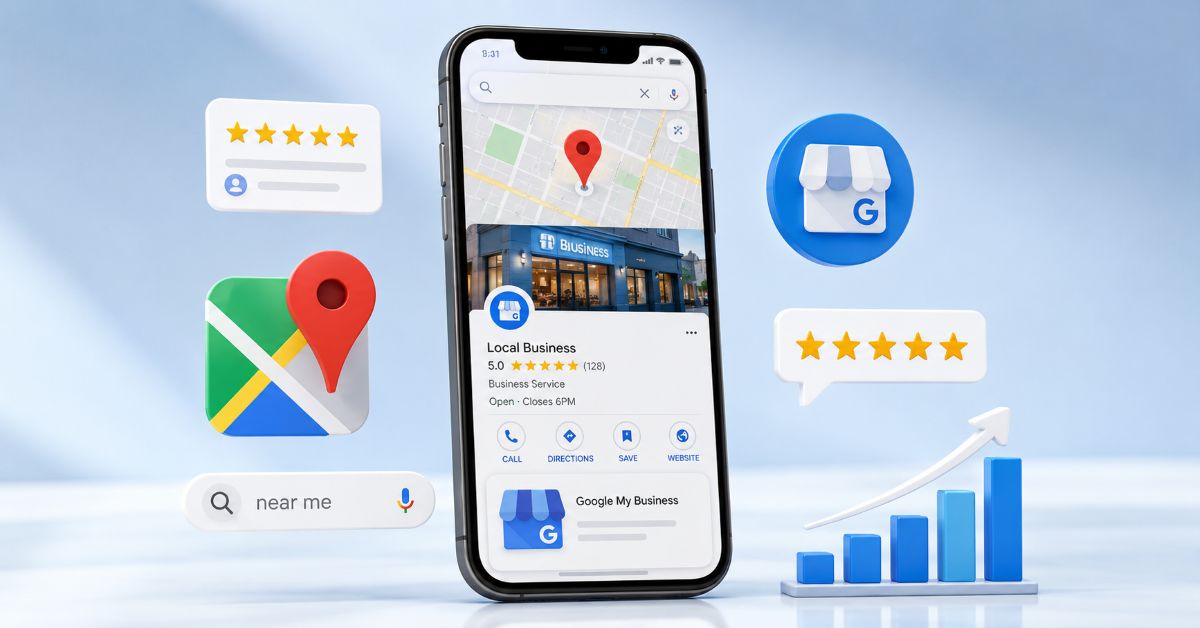
Your Business Profile in 2026: The Complete Guide to Dominating Local Search
In 2026, nearly 46% of all Google searches have local intent — people searching for businesses, services, and products near them. Of those searchers, 76% visit a business within 24 hours of performing a local search on their smartphone, and 28% of local searches result in a purchase within a day. These are not marginal statistics — they represent the most commercially valuable segment of search traffic available to any business that serves a local market. And the most powerful tool for capturing that traffic is not paid advertising, social media, or even traditional website SEO. It is Local profile optimization.
Google My Business SEO — the practice of optimizing your Google Business Profile to appear prominently in local search results, Google Maps, and the coveted “local 3-pack” — is the highest-ROI local marketing activity available to brick-and-mortar businesses, service-area businesses, and any organization whose customers are concentrated in specific geographic markets. Google Business Profile (formerly Google My Business) is free, directly connected to Google’s local search algorithm, and maintained by billions of users who rely on it for business discovery every day.
Yet despite its enormous commercial impact, the majority of businesses either have incomplete Google Business Profiles, have never implemented systematic local optimization, or are missing the optimization opportunities that separate businesses in position one of the local 3-pack from those buried on page two of Maps results. This guide covers the complete Google My Business SEO system: what it is, how it works, every optimization factor that influences local ranking, and the step-by-step approach that produces measurable local visibility improvements in 2026.
| Google My Business SEO Factor | Ranking Impact | Difficulty | Time to Impact |
|---|---|---|---|
| Business profile completeness | 🔥 Very High | Easy | Days |
| Primary & secondary categories | 🔥 Very High | Easy | Days |
| NAP consistency (Name, Address, Phone) | 🔥 High | Medium | Weeks |
| Customer reviews & rating | 🔥 Very High | Ongoing | Months |
| Google Posts activity | ✅ Medium | Easy | Weeks |
| Photos & media | ✅ Medium-High | Easy | Weeks |
| Local citations & directories | 🔥 High | Medium | Weeks–Months |
| Website SEO signals | 🔥 High | Medium-Hard | Months |
What Is Google My Business SEO?
Google My Business SEO is the practice of optimizing a business’s presence on Google’s local search ecosystem — primarily through the Google Business Profile — to improve visibility in local search results, Google Maps, and the local 3-pack (the block of three local business listings that appears at the top of Google results for location-based queries). Unlike traditional website SEO that focuses on organic search rankings in the standard blue-link results, Your Business Profile operates within a distinct local search algorithm that weighs three primary factors: relevance, distance, and prominence.
According to Wikipedia’s overview of Google Business Profile, Google launched what was originally called Google My Business in 2014 as a unified platform for businesses to manage their presence across Google Search and Google Maps. In 2021, it was rebranded to Google Business Profile, reflecting its deeper integration into Google’s broader local search infrastructure. Despite the rebrand, the industry continues to widely use the term “Google My Business SEO” to describe the discipline of optimizing this profile for local search visibility.
Businesses with fully optimized profiles receive 7x more clicks than those with incomplete listings, and adding photos increases direction requests by 42% and website visits by 35%, according to Google’s own published data. These performance differences highlight why systematic local optimization produces such immediate, measurable impact for local businesses compared to other marketing investments that take months to show results.
How Google’s Local Search Algorithm Works
To execute effective local optimization, you need to understand the three factors Google’s local algorithm uses to rank businesses in Maps and the 3-pack. Every Google My Business SEO decision you make either strengthens or weakens your performance across these three dimensions.
Relevance: Does Your Business Match the Search Query?
Relevance in Google My Business SEO refers to how well your business profile matches what the searcher is looking for. A plumber’s profile optimized for “emergency plumbing services” is highly relevant for that query — while a generic profile with minimal category and service information appears less relevant even if the business offers identical services. profile optimization for relevance centers on selecting the most accurate primary category, adding comprehensive secondary categories, completing all service and product sections, and writing a business description that naturally includes the terms your customers search for.
Distance: How Close Is Your Business to the Searcher?
Distance is the Google My Business SEO factor you control least — your physical location is fixed. However, the way you define your service area in Google Business Profile affects how Google interprets your geographic relevance for different queries. For service-area businesses (plumbers, electricians, cleaning services) that travel to customers rather than having customers visit a fixed location, properly defining your service area in Google My Business SEO settings is critical — it tells Google which geographic zones to include you in for local results.
Prominence: How Well-Known and Trusted Is Your Business?
Prominence is the Google My Business SEO factor most influenced by your overall digital marketing footprint — including the number and quality of customer reviews, your website’s SEO authority, mentions in local publications, backlinks from local sources, and how consistently your business information appears across the web. Google My Business SEO prominence signals are cumulative: every positive review, every high-quality local citation, and every backlink from a relevant local website contributes to the prominence score that influences your 3-pack ranking.
Setting Up Your Google Business Profile for Maximum SEO Impact
The foundation of effective local optimization is a complete, accurate, and fully verified Google Business Profile. Surprisingly, a significant percentage of businesses never complete this foundational step — leaving optimization opportunities and local ranking potential untapped. Google’s Business Profile support center provides the official setup guidance, but these optimization principles take you beyond basic setup into genuine profile performance.
Business Name Optimization
Your business name in Google My Business SEO should exactly match your real-world business name — nothing more. Google’s guidelines explicitly prohibit keyword stuffing in business names (adding “| Best Plumber in Dallas” to a business called “Smith Plumbing”). Violating this guideline is one of the most common Google My Business SEO mistakes and can result in profile suspension. The business name field is not for keyword optimization — the category, description, and services sections are the correct Your Business Profile locations for keyword targeting.
Category Selection: The Most Important Google My Business SEO Decision
Category selection is arguably the single most impactful Google My Business SEO decision you make. Your primary category tells Google precisely what type of business you operate and determines which search queries you are eligible to appear for in the 3-pack. Secondary categories expand this eligibility to related services.
Google My Business SEO best practices for categories: select the most specific primary category that accurately describes your main business (not the broadest category that technically applies), add all relevant secondary categories for additional services you offer, and research what categories your top-ranking competitors use — competitor category analysis is one of the most underutilized Google My Business SEO intelligence tactics available.
Address and Service Area Configuration
For storefront businesses, your address in Google My Business SEO must be accurate, complete, and exactly consistent with how it appears in other online directories. This NAP (Name, Address, Phone) consistency is a foundational local ranking signal — inconsistencies across citations confuse Google’s local algorithm and suppress ranking. For service-area businesses that do not serve customers at a physical location, hiding the address and defining service areas by city, region, or zip code is the correct Your Business Profile configuration.
The 8 Core profile optimization Factors
Beyond basic profile setup, systematic local optimization requires optimizing across eight high-impact factors that directly influence local ranking and customer engagement performance.
1. Business Description Optimization
The Google Business Profile description (750-character limit) is a Google My Business SEO opportunity that most businesses waste with generic language about how long they have been in business. effective local optimization uses the description to naturally incorporate primary service keywords, mention the specific geographic areas you serve, include a compelling value proposition, and end with a clear call to action — all within the 750-character limit that Google displays in full on the profile.
2. Google Posts: Regular Fresh Content Signals
Google Posts allow businesses to publish updates, offers, events, and product announcements directly to their Google Business Profile — appearing in the profile’s card in local search results. For Google My Business SEO, regular posting demonstrates active business management (a positive relevance signal), provides additional keyword-rich content that Google indexes within your profile, and gives searchers compelling reasons to choose your business over competitors. Businesses posting at minimum once weekly consistently show improved Google My Business SEO engagement metrics compared to inactive profiles.
3. Photos and Visual Media
Photo quantity and quality is a local rankings signal with direct behavioral impact. Profiles with 100+ photos receive significantly more calls, direction requests, and website visits than those with fewer than 10 images. Google My Business SEO photo strategy covers: exterior photos (from multiple approaches, at different times of day), interior photos, team and staff photos, product or service photos, and regularly updated photos showing seasonal offerings or recent work. Photo file names and descriptions present minor Your Business Profile keyword opportunities that thorough practitioners do not overlook.
4. Customer Reviews: The Most Powerful local ranking Signal
Customer reviews are simultaneously the most powerful local ranking factors and the most powerful conversion factor for local businesses — making review management the highest-leverage Your Business Profile activity most businesses can invest in. Google’s local algorithm considers review quantity, average rating, review recency, and review keywords when determining local ranking positions.
The Google My Business SEO review strategy that consistently works: actively request reviews from every satisfied customer through post-purchase email sequences, direct follow-up calls, or in-person requests with a direct link to your review page; respond professionally and promptly to every review (positive and negative); and never use review gating (filtering customers before directing them to Google) or offer incentives for reviews — both violate Google’s guidelines and risk profile penalties that devastate profile performance.
5. Q&A Section Management
The Questions and Answers section of your Google Business Profile is a frequently neglected Google My Business SEO opportunity. Anyone can post a question on your profile — and anyone can answer it, including competitors or uninformed third parties. Google My Business SEO best practice is to proactively populate the Q&A section with the questions your customers most frequently ask, answer them comprehensively yourself, and monitor for new questions that require accurate, prompt responses. Questions and answers are indexed by Google and can appear in search results, providing additional keyword-rich content that supports Your Business Profile relevance signals.
6. Products and Services Sections
Completing the Products and Services sections in Google Business Profile is an underutilized optimization tactic that expands the keyword footprint of your profile significantly. Each product and service entry can include a name, description, and price — all of which are indexed content that Google associates with your business profile. Google My Business SEO practitioners who complete these sections with keyword-rich, accurate descriptions consistently see expanded local ranking coverage for service-specific queries compared to profiles with empty product/service sections.
7. Messaging and Booking Features
Enabling messaging and booking features in Google Business Profile provides both conversion utility for customers and a Google My Business SEO engagement signal. Google’s algorithm interprets active customer engagement with Business Profile features (messaging, booking, phone calls via profile) as a prominence and relevance indicator. Businesses with high engagement rates on their Business Profile features typically perform better in local rankings than comparable businesses with low engagement, suggesting that profile interaction data influences local algorithm positioning.
8. Attributes and Highlights
Business attributes — accessibility features, payment methods, parking, amenities, and identity-based attributes — are local ranking signals that match specific search filters users apply. A business that correctly marks “wheelchair accessible entrance” appears in filtered searches for accessible businesses. A restaurant marking “outdoor seating” appears in filtered dining searches. Completing all applicable attributes is a optimization step that takes minutes but expands your visibility in filtered and specific-intent local searches that competitors with incomplete attributes do not appear in.
NAP Consistency and Local Citations: The Off-Profile Side of Google My Business SEO
Google My Business SEO extends beyond the profile itself to encompass how your business information appears across the broader web. Local citations — mentions of your business Name, Address, and Phone number (NAP) in online directories, review platforms, news articles, and local websites — are foundational Your Business Profile authority signals that the local algorithm uses to verify business legitimacy and assess prominence.
Why NAP Consistency Matters for Google My Business SEO
When your business name appears as “Smith Plumbing” on your Google Business Profile but “Smith’s Plumbing Services LLC” on Yelp and “Smith Plumbing Co.” on the local Chamber of Commerce directory, Google’s algorithm encounters conflicting signals about your business identity. This NAP inconsistency suppresses profile performance by reducing the algorithm’s confidence in your business data — a confidence factor that directly influences local ranking.
Auditing and correcting NAP inconsistencies across the top 30-50 local citation sources is one of the highest-impact technical optimization activities for businesses experiencing ranking stagnation despite otherwise well-optimized profiles. Tools like BrightLocal, Whitespark, and Moz Local automate citation auditing and management at scale for Google My Business SEO practitioners managing multiple locations.
Priority Citation Sources for Google My Business SEO
The most valuable citation sources for Google My Business SEO in the US market include: Yelp, Apple Maps, Bing Places, Facebook Business, Foursquare, Better Business Bureau, Chamber of Commerce, Yellow Pages, Angie’s List (now Angi), and industry-specific directories relevant to your business category. Each accurate, consistent citation strengthens the prominence signals that support your Your Business Profile ranking — with citations from authoritative, relevant sources carrying proportionally greater weight than citations from low-quality general directories.
Google My Business SEO for Small Businesses: Competing Against Larger Competitors
One of the most significant advantages of Google My Business SEO for small businesses is its ability to level the local competitive playing field against much larger competitors. A national chain’s corporate SEO team and website domain authority provide significant advantages in traditional organic search — but Your Business Profile factors like review recency, local relevance, customer engagement, and genuine community presence favor the small business owner who actively manages their local presence over the national brand managing thousands of locations from a corporate office.
The Google My Business SEO factors that small businesses can consistently outperform large competitors on: review velocity (actively requesting reviews from every customer produces faster accumulation than passive collection), photo freshness (a small business owner can add new photos weekly; a franchise may update photos annually), response quality (a business owner’s personal, thoughtful review responses build trust that corporate template responses cannot match), and local post relevance (content directly relevant to the local community outperforms generic corporate content).
Local SEO Optimization for Small Business Priorities
For small businesses beginning their the local SEO journey, a prioritized approach produces faster results than attempting to optimize everything simultaneously. Start with the highest-impact local SEO fundamentals: verify the profile, select the precise primary category, complete all business information sections accurately, add a minimum of 10 high-quality photos, and enable the review request system. These foundational steps produce measurable local ranking improvement before proceeding to advanced Your Business Profile tactics like posts strategy, Q&A management, and citation building. For a comprehensive local ranking strategy that combines Local profile optimization with website optimization, explore our local SEO services at Arb Digital Marketing Agency.
Measuring profile performance
Google Business Profile provides built-in performance data through its Insights section — giving businesses free access to the metrics that reveal whether their optimization efforts are producing measurable results. Understanding these metrics allows for data-driven Your Business Profile optimization rather than guesswork.
Key Google My Business SEO Metrics
- Search impressions (Discovery vs. Direct): Discovery impressions show how many users found your business searching for a category, product, or service — the primary Google My Business SEO traffic metric. Direct impressions show users who searched specifically for your business name, measuring brand awareness rather than Your Business Profile reach.
- Actions (Calls, Directions, Website Clicks): These behavioral metrics reveal how effectively your Google Business Profile converts impressions into customer actions. profile optimization should improve both impression volume and action rate simultaneously — high impressions with low actions indicate profile content or offer quality issues.
- Photo views and quantity: Photo view data reveals which images customers engage with most, informing Google My Business SEO photo strategy updates. Adding new high-performing photo types consistently improves profile engagement metrics.
- Review metrics: Average star rating and review volume over time are the Google My Business SEO reputation metrics most directly connected to local ranking performance and conversion rate.
According to BrightLocal’s Local Consumer Review Survey, 98% of consumers read online reviews for local businesses, and the average consumer reads 10 reviews before feeling they can trust a business. These behavioral statistics underscore why Google My Business SEO review management is not a minor optimization detail — it is one of the two or three most commercially significant factors in local business performance.
Common Google My Business SEO Mistakes That Suppress Local Rankings
- Selecting an inaccurate primary category: Choosing a broad or slightly inaccurate primary category is one of the most common Google My Business SEO errors. A personal injury lawyer selecting “Lawyer” instead of “Personal Injury Attorney” misses the specific category matching that the local algorithm uses to match profiles to specific queries. Audit your primary category against both Google’s available options and what your top-ranked competitors have selected.
- Incomplete profile information: Google explicitly states that complete profiles rank higher than incomplete ones. Every empty section in your Google Business Profile is a Google My Business SEO opportunity missed. Hours of operation, website URL, service area, attributes, products, and services — complete every applicable section.
- Ignoring reviews: Businesses that passively hope for reviews and never respond to existing ones are leaving the most powerful local ranking signal completely unmanaged. A systematic review request process and consistent response practice is non-negotiable for competitive local rankings.
- Inconsistent business hours: Inaccurate or outdated hours — particularly for holidays and special closures — create negative user experiences that Google’s algorithm detects through behavioral signals and incorporates into local ranking calculations. Keep hours updated as a routine profile maintenance task.
- Never publishing Google Posts: Inactive profiles with no post history signal to Google’s algorithm that the business is not actively maintained — reducing relevance scores compared to competitors posting regular, keyword-rich content updates. Establish a weekly or bi-weekly Google Post schedule as part of ongoing this practice.
- Duplicate listings: Multiple Google Business Profile listings for the same business location create NAP inconsistency signals that severely damage profile performance. Audit for duplicates and request removal through Google’s reporting tools before investing in other optimization activities.
Advanced local Strategies for 2026
AI-Powered Local Search Adaptation
Google’s AI Overviews and Gemini integration are reshaping how local search results appear for informational queries — but the core local ranking signals (relevance, distance, prominence) remain the primary determinants of 3-pack and Maps visibility. In 2026, Your Business Profile adaptation for AI search means ensuring your profile and website content together provide the structured, factual information that AI synthesis draws from: specific services with descriptions, accurate business details, and genuine customer testimonials that AI systems can cite as evidence of business quality.
Local Content Strategy Supporting Google My Business SEO
Google My Business SEO does not operate in isolation from your website’s organic SEO performance. Google’s local algorithm explicitly incorporates website authority and relevance signals into local ranking calculations — meaning a business with strong Your Business Profile fundamentals AND strong local landing page SEO consistently outranks competitors with a well-optimized profile but a weak or uncorrelated website presence.
The Google My Business SEO-supporting content strategy: create individual location pages for each business location with locally specific content, optimize your website for the same service-plus-location keyword combinations you target in your Business Profile, earn local backlinks from community organizations and local media, and maintain consistent NAP information across your website, profile, and all external citations.
For the complete organic SEO foundation that supports and amplifies your local optimization results, our SEO marketing guide covers the website optimization strategies that work alongside local search optimization for comprehensive local visibility. And for the broader digital marketing context, our digital marketing complete guide provides the strategic framework.
Frequently Asked Questions About Google My Business SEO
What is Google My Business SEO?
Your Business Profile is the practice of optimizing your Google Business Profile and related local signals to improve your business’s visibility in Google local search results, Google Maps, and the local 3-pack. It involves optimizing your business profile’s completeness, category accuracy, reviews, photos, posts, and off-profile citation consistency to improve your ranking across Google’s three local algorithm factors: relevance, distance, and prominence.
How does Google My Business SEO differ from regular SEO?
Regular SEO focuses on improving your website’s organic ranking in the standard search results (the blue link listings). Google My Business SEO focuses on your Business Profile ranking in the local 3-pack, Maps results, and location-specific queries. Both use overlapping signals — website authority influences local ranking, and local authority can influence organic ranking — but Your Business Profile operates within a distinct algorithm that additionally weights proximity and profile-specific factors like reviews and profile completeness that regular SEO does not consider.
How long does Google My Business SEO take to show results?
Basic Google My Business SEO improvements — completing profile information, fixing category errors, adding photos — can produce ranking improvements within days to weeks. Review accumulation and citation building produce ranking improvements over one to three months of consistent effort. Comprehensive Your Business Profile programs combining profile optimization, review management, citation building, and supporting website SEO typically show significant local ranking improvements within three to six months, with continued improvement over 12+ months as prominence signals compound.
Does Google My Business SEO work for service-area businesses?
Yes — Google My Business SEO is equally valuable for service-area businesses (plumbers, electricians, cleaners, landscapers) as for storefront businesses. Service-area business Your Business Profile requires specific configuration: hide the physical address if customers do not visit your location, define service areas by city or zip code, and focus on the relevance and prominence factors (categories, reviews, website optimization) that compensate for the distance factor being less precisely calculable for mobile businesses.
What are the most important local ranking factors?
According to Moz’s annual Local Search Ranking Factors survey, the most influential local ranking signals include: primary category accuracy, keyword presence in reviews, proximity to searcher, NAP consistency across citations, website domain authority, review quantity and average rating, review recency, behavioral signals (clicks, calls, direction requests), and Google Posts activity. Of these, category accuracy and review management consistently emerge as the highest-leverage Your Business Profile factors for businesses with complete, verified profiles.
Is Google My Business SEO free?
Google Business Profile itself is completely free — there is no cost to create, verify, or maintain your listing. profile optimization activities — completing your profile, publishing posts, requesting reviews, responding to questions — require time investment but no direct payment to Google. The costs associated with Your Business Profile are typically professional service fees if you hire an agency or consultant, subscription costs for citation management tools, and the staff time required to implement and maintain your optimization program.
Conclusion: Google My Business SEO Is the Most Direct Path to Local Customer Growth
For any business competing in local markets, Google My Business SEO is not a supplementary marketing activity — it is the core channel through which local customers discover, evaluate, and choose businesses like yours. With 46% of Google searches having local intent and 76% of local searchers visiting a business within 24 hours, the commercial impact of strong local 3-pack visibility is immediate, measurable, and directly proportional to the quality of your Your Business Profile execution.
The businesses winning in local search in 2026 are not those with the largest marketing budgets — they are those with the most complete, accurate, and actively managed Google Business Profiles, the most genuine and consistent review accumulation, and the tightest alignment between their online presence and what local customers are searching for. Every component of Google My Business SEO is achievable for any business willing to invest the systematic effort that the discipline requires.
Start with the fundamentals: verify and complete your profile, select accurate categories, establish a review request system, and publish your first Google Posts. Then build toward the advanced local strategies — citation management, Q&A optimization, photo strategy, and the website SEO signals that amplify your local ranking authority. The compounding returns from systematic local optimization build a local search presence that produces qualified customer inquiries continuously — from the most commercially valuable searchers on the internet. Visit our marketing blog for ongoing Your Business Profile updates and local search strategy guidance through 2026.


Subscribe to receive in-depth reviews, honest comparisons, and practical recommendations that help you choose the right products with confidence.
Newsletter coming soonNo spam. No hype. Just clear, helpful insights.