Introduction
Picture this: a small bakery in your neighbourhood posts one short video of a chocolate cake on Instagram. By the next morning, 40 new people have messaged to place orders — without the owner spending a single rupee on a billboard or a newspaper ad. A decade ago, that would have sounded like magic. Today, it’s just an ordinary Tuesday for any business that understands how to market online.
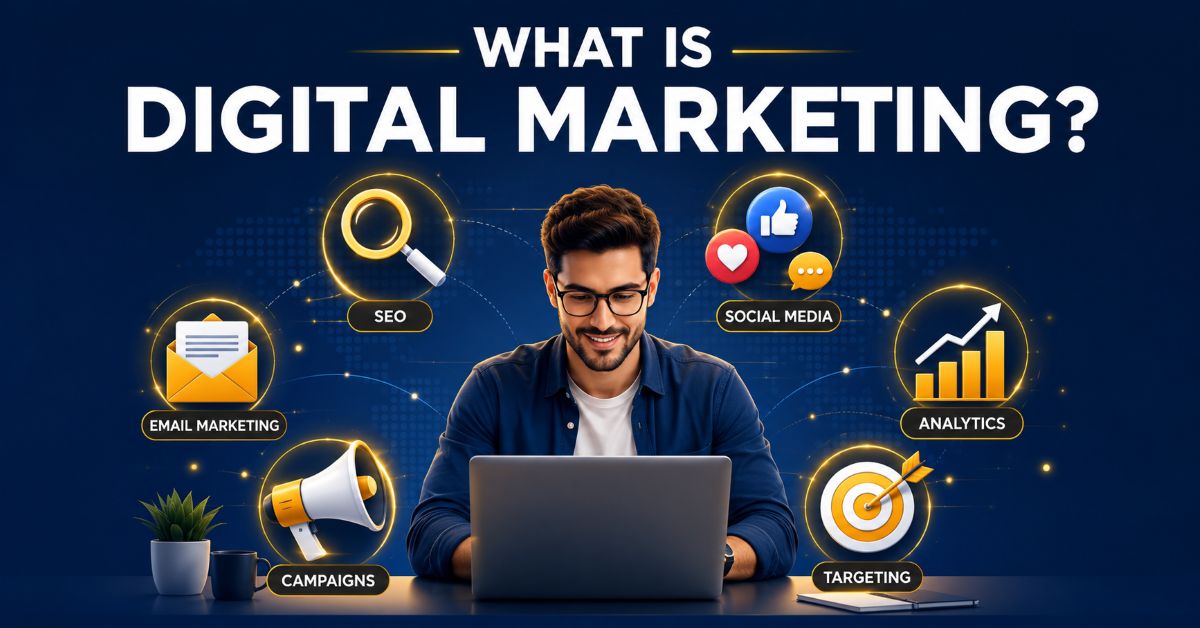
What is digital marketing? In the simplest terms, it’s the art and science of promoting your products, services, or brand using the internet and digital devices — search engines, websites, social media, email, and mobile apps. If you’ve ever clicked a Google ad, watched a sponsored reel, compared products on your phone, or opened a promotional email, you’ve already experienced it from the customer’s side.
This guide is built to take you from zero to confident. We’ll cover a clear definition, a short history of how we got here, exactly how the system works, every major channel, the tools and metrics that matter, real budgets, common mistakes, and a step-by-step roadmap for beginners. Grab a coffee — by the end, you’ll understand this field well enough to plan your own strategy or hire the right help. Let’s begin.
Quick answer: Digital marketing is any marketing effort that uses an electronic device or the internet to connect with potential customers — including SEO, paid ads, social media, content, and email.
What Is Digital Marketing? A Clear Definition
Let’s keep the definition clean and useful: digital marketing is the use of online channels, platforms, and technologies to promote and sell products or services to a targeted audience. It works alongside — or completely replaces — older methods like print, radio, and television with tactics that are measurable, precisely targeted, and surprisingly affordable. (For another respected take, HubSpot defines it in much the same way.)
But the real meaning runs deeper than “advertising on the internet.” It covers the entire customer journey: how people first discover your brand, how they research and compare their options, how they engage with what you share, how they finally buy, and how they become loyal, repeat customers who recommend you to others. Think of it less as a single tool and more as a complete ecosystem for attracting, nurturing, and keeping customers.
Three qualities make this approach so powerful, and they’re worth memorising:
- It’s measurable. Every click, view, scroll, and sale can be tracked — no more guessing which half of your budget is wasted.
- It’s targeted. You can reach very specific people based on their age, interests, location, search history, and online behaviour.
- It’s flexible. A campaign can be tweaked, paused, or scaled in real time; a printed flyer, once mailed, can never be changed.
That measurability is exactly why businesses of every size are shifting their budgets online. The global digital advertising market now runs into hundreds of billions of dollars each year and continues to outpace traditional media, according to Statista. When you understand what is digital marketing at this level, you start to see it everywhere — because it genuinely is.
A Short History: How We Got Here
It helps to know how this field evolved, because it explains why it works the way it does today.
- The 1990s brought the first websites, the launch of search engines, and the very first banner ads. Marketing online was experimental and clunky.
- The 2000s gave us Google’s dominance, the birth of SEO, the launch of Google AdWords (now Google Ads), and the rise of early social networks.
- The 2010s were defined by the smartphone. Suddenly, the internet lived in everyone’s pocket, and social media, video, and mobile apps exploded. Today, roughly two-thirds of the world’s population is online, per Pew Research Center and global connectivity reports.
- The 2020s are all about data, personalisation, short-form video, privacy changes, and — most recently — artificial intelligence transforming how content is made and how people search.
The lesson? The tools change constantly, but the goal never does: reach the right people with the right message and turn attention into action.
How Does Digital Marketing Actually Work?
Behind every successful campaign is a surprisingly simple four-stage cycle — often called the marketing funnel:
- Attract (Awareness) — Use channels like SEO, social media, and ads to bring strangers to your website or profiles. At this stage, people don’t know you yet.
- Engage (Consideration) — Share genuinely helpful content — blogs, videos, emails — that builds trust and answers their questions while they compare options.
- Convert (Decision) — Guide interested visitors toward a clear action: a purchase, a sign-up, a download, or a phone call.
- Retain & Delight (Loyalty) — Keep customers coming back through email, loyalty offers, great service, and remarketing — turning buyers into fans.
What ties all four stages together is data. Tools like Google Analytics, ad dashboards, and customer-relationship-management (CRM) systems — such as Salesforce — quietly collect signals about your audience: what they search for, what they click, what they buy, and what they ignore. Marketers then use those signals to show the right message, to the right person, at the right moment.
As Think with Google regularly highlights, this intent-based targeting is what makes online campaigns far more efficient than traditional guesswork. Instead of shouting at everyone and hoping, you speak directly to people who are already interested.
In short: test, measure, learn, improve — and repeat. That feedback loop is the real engine of the entire field, and it’s why digital campaigns get smarter and cheaper over time.
Digital Marketing vs. Traditional Marketing
A quick side-by-side makes the difference crystal clear:
| Feature | Traditional Marketing | Digital Marketing |
|---|---|---|
| Reach | Local / limited | Global |
| Cost | Often high upfront | Scalable — start small |
| Targeting | Broad, one-size-fits-all | Highly specific |
| Results | Hard to measure | Fully trackable |
| Speed | Slow to launch and change | Real-time adjustments |
| Interaction | One-way | Two-way conversation |
The biggest win here is control. You decide who sees your message, how much you spend, and you can pause or scale a campaign in seconds. A newspaper ad costs the same whether two people or two thousand respond; an online ad lets you pay for results and switch off whatever isn’t working. Research from firms like Nielsen consistently shows how measurable digital channels have reshaped where brands invest.
That said, traditional marketing isn’t dead — billboards, events, and print still have their place. The smartest brands blend both worlds. But for most businesses today, especially those starting with a limited budget, going digital simply offers a more affordable, measurable, and far-reaching toolkit.
The Main Types of Digital Marketing
This isn’t one single activity — it’s a family of connected channels, each with its own strengths. Here are the ones every beginner and business owner should understand.
1. Search Engine Optimization (SEO)
SEO is the practice of optimising your website so it ranks higher in unpaid (organic) Google search results. Higher rankings mean a steady stream of free, high-intent traffic from people actively searching for what you offer. It involves keyword research, well-written content, fast and mobile-friendly pages, and earning trustworthy links from other sites.
Best for: long-term, compounding growth. Downside: it takes months to build momentum. Beginner-friendly resources include Google Search Central, Moz, Semrush, and Ahrefs. For daily news, Search Engine Journal is excellent. (Need help ranking? Explore our SEO services.)
2. Pay-Per-Click (PPC) Advertising
With PPC, you pay a small fee each time someone clicks your ad — most commonly through Google Ads or social media platforms. Unlike SEO, it delivers instant visibility at the top of search results or in users’ feeds.
Best for: fast results, product launches, and testing offers. Downside: traffic stops the moment you stop paying. Helpful learning hubs include WordStream. (See our Google Ads & PPC management.)
3. Social Media Marketing
This channel uses platforms like Facebook, Instagram, LinkedIn, TikTok, and YouTube to build brand awareness, engage your audience, and drive sales — both organically (free posts) and through paid ads. With more than 5 billion social media users worldwide, according to DataReportal, the opportunity is staggering. To run paid campaigns, you’ll work inside tools like Meta for Business, and platforms like Sprout Social publish useful research.
Best for: brand building, community, and visual products. (Learn about our social media marketing and dedicated Facebook & Instagram Ads services.)
4. Content Marketing
Content marketing is the creation and distribution of valuable material — blog posts, videos, ebooks, infographics, podcasts — to attract and retain a clearly defined audience. It quietly powers almost every other channel: your SEO needs content to rank, your social posts need content to share, and your emails need content to be worth opening. The Content Marketing Institute is the go-to authority on this discipline.
Best for: building authority and trust over time. (Explore our content marketing services.)
5. Email Marketing
Email remains one of the highest-ROI channels in existence. Research from Litmus suggests email can return roughly $36 for every $1 spent. Because you own your email list (unlike rented social media followers), it’s perfect for nurturing leads and keeping customers. Popular beginner platforms include Mailchimp.
Best for: retention, nurturing, and direct sales. (Start with our email marketing services.)
6. Affiliate Marketing
Here, partners promote your products and earn a commission on every sale they generate. It’s a low-risk, performance-based model — you only pay when results come in — that lets you tap into audiences far larger than your own. (See how we run affiliate marketing campaigns.)
7. Influencer Marketing
You partner with creators who already have the trust of your target audience. A single well-placed recommendation from the right influencer can drive more sales than a month of ads, because it comes with built-in credibility. The Influencer Marketing Hub tracks the latest benchmarks in this fast-growing space.
8. Video Marketing
From YouTube tutorials to short-form reels, video is now one of the most engaging formats online — surveys by Wyzowl show the vast majority of marketers consider it essential. It explains complex products quickly, builds emotional connection, and tends to be favoured by social media algorithms. (Reach viewers with our YouTube advertising service.)
9. Mobile & SMS Marketing
This includes text-message campaigns, app-based promotions, and push notifications. With the majority of web traffic now coming from smartphones, a mobile-first mindset is no longer optional — it’s essential.
Digital Marketing Channels at a Glance
If you remember just one list from this guide, make it this one. The core channels are:
- Organic search (SEO)
- Paid search & display (PPC, Google Ads)
- Social media (organic + paid)
- Content (blog, video, podcasts)
- Email & SMS
- Affiliate & influencer
- Referral & online reviews
The best campaigns rarely rely on a single channel — they combine several so each one reinforces the others. SEO brings long-term traffic, PPC fills the gaps with instant visibility, content gives people a reason to trust you, and email turns that trust into repeat sales. This multi-channel mix is where real, compounding growth happens.
Inbound vs. Outbound: Two Philosophies
You’ll often hear marketers talk about “inbound” and “outbound.” The difference is simple:
- Inbound marketing attracts people to you by offering something valuable — a helpful blog, a free guide, an entertaining video. Customers come to you when they’re ready.
- Outbound marketing reaches out to people directly — cold emails, display ads, pop-ups — whether they asked for it or not.
Neither is “better.” Inbound builds trust and tends to be cheaper over time; outbound delivers faster reach. Most strong strategies use a healthy mix of both.
B2B vs. B2C Digital Marketing
Who you sell to changes how you market. B2C (business-to-consumer) marketing targets individuals — think the bakery selling cakes. It’s often emotional, visual, and fast-moving, with channels like Instagram and TikTok doing the heavy lifting.
B2B (business-to-business) marketing targets other companies. The sales cycle is longer, decisions are more logical, and the budget is bigger. Channels like LinkedIn, email, SEO, and in-depth content (case studies, whitepapers) tend to work best — which is why LinkedIn Marketing Solutions is a B2B favourite. Understanding which model you’re in keeps you from wasting time on the wrong channels.
A Real-World Example
Let’s go back to that bakery and watch the channels work together:
- SEO: A blog post titled “Best Birthday Cakes in [City]” ranks on Google and brings in steady local traffic month after month.
- Social media: Daily reels of fresh cakes build a loyal following and trigger word-of-mouth shares.
- PPC: A small Google Ads budget captures people searching “cake delivery near me” at the exact moment they want to buy.
- Email: A monthly newsletter with a discount code brings past customers back for birthdays and holidays.
- Reviews: Happy customers leave 5-star Google reviews, which boost both trust and local rankings — and smart brands protect that trust with active online reputation management.
No single tactic did all the heavy lifting — together, they turned a tiny shop into a local favourite. That synergy is the whole point of marketing online, and it works just as well for a software company, a clothing brand, or a consultant.
What Is a Digital Marketing Strategy?
Knowing the channels is one thing; using them with a plan is another entirely. A digital marketing strategy is simply a documented plan that defines your goals, your target audience, your chosen channels, your budget, and how you’ll measure success.
A beginner-friendly framework looks like this:
- Set clear, specific goals. “Get more sales” is vague. “Generate 30% more leads in six months” is a goal you can actually measure.
- Define your audience. Build a simple profile of your ideal customer — their age, problems, and where they hang out online.
- Choose your channels based on where that audience actually spends time, not where you find it most fun.
- Build a content & campaign calendar so you publish consistently instead of in random bursts.
- Measure, analyse, and optimise every month, doubling down on what works and cutting what doesn’t.
Without a strategy, even great tactics produce scattered, disappointing results. The plan is the bridge between knowing the theory and actually profiting from it.
Essential Digital Marketing Tools
You don’t need an expensive software stack to start. A handful of free and affordable tools cover the essentials:
- Google Analytics — see who visits your site and what they do there.
- Google Search Console — track how you appear in Google search.
- Google Keyword Planner — research what your audience is searching for.
- Canva — design professional graphics without a designer.
- An email platform (like Mailchimp) — build and send newsletters.
- A social scheduler (like Buffer or Meta Business Suite) — plan posts in advance.
Start with the free options, master them, and only upgrade to paid tools once you clearly understand what you need.
Key Metrics & KPIs to Track
The phrase “what gets measured gets improved” is the heartbeat of online marketing. These are the numbers that actually matter:
- Traffic — how many people visit your site, and from which channels.
- Conversion rate — the percentage of visitors who take your desired action.
- Cost per click (CPC) and cost per acquisition (CPA) — what you pay for a click and for a new customer.
- Click-through rate (CTR) — how often people click your ads, links, or emails.
- Return on investment (ROI) and return on ad spend (ROAS) — the bottom line: is this making money?
- Customer lifetime value (CLV) — how much a customer is worth over their entire relationship with you.
You don’t need to track everything from day one. Pick two or three metrics tied directly to your goals, and let the data guide your decisions.
The Key Benefits of Digital Marketing
So why does all of this matter? Because the advantages are exactly why marketing online has become essential rather than optional:
- Affordable & scalable — Start with a tiny budget and grow as returns come in.
- Measurable ROI — Track every rupee, click, and conversion with precision.
- Precise targeting — Reach the exact people most likely to buy, not random crowds.
- Global reach — Sell beyond your street, your city, or even your country.
- Two-way engagement — Build genuine relationships and gather real feedback.
- Faster feedback — Launch today, learn from the data tomorrow, improve next week.
- Levels the playing field — A clever small business can outrank a sluggish giant.
These benefits explain why companies everywhere are moving their budgets online — and why digital ad spend has now overtaken traditional media in most major markets.
How Much Does Digital Marketing Cost?
One of the best things about marketing online is that you can start for almost nothing. Here’s a realistic picture:
- Organic channels (SEO, social media posts, content) cost mostly time, not money — perfect for tight budgets.
- Paid ads can begin with as little as a few dollars a day, and you control the ceiling.
- Tools often have generous free tiers, with paid plans as you scale.
- Hiring an agency or freelancer costs more upfront but saves time and accelerates results.
The smart approach is to start small, prove what works, and reinvest your profits into the channels delivering the best return. You rarely need a big budget — you need a focused one.
Digital Marketing for Beginners: A Step-by-Step Roadmap
Good news: you don’t have to master everything at once. Here’s a realistic roadmap:
- Build a fast, mobile-friendly website. This is your home base — everything else points back to it. (If you’d rather not DIY, our web design & development team can handle it.)
- Pick ONE channel to start — usually SEO or social media, depending on where your audience lives.
- Create helpful content consistently. Answer the real questions your customers ask.
- Set up free tools like Google Analytics and Google Search Console from day one.
- Test small paid ads once you understand your audience and your message.
- Track results and double down on whatever is working.
- Expand gradually into a second and third channel as you grow.
The classic beginner mistake is trying every channel at once and burning out within a month. Master one, prove it works, then expand. Free training like the Google Digital Garage, HubSpot Academy, and Meta Blueprint are excellent, no-cost places to build your foundation.
Skills Every Digital Marketer Needs
If you’re considering this as a career, here are the skills that make someone genuinely good at it:
- Analytical thinking — comfort with numbers and data.
- Writing & communication — clear words sell.
- Creativity — fresh ideas cut through the noise.
- Adaptability — the tools change every year, so curiosity is a superpower.
- Basic design and tech literacy — enough to be dangerous with tools like Canva and WordPress.
The encouraging part? Every one of these can be learned through platforms like Coursera. Because nearly every business now needs an online presence, demand for skilled marketers continues to grow rapidly worldwide.
What Does a Digital Marketing Agency Do?
Not everyone has the time or expertise to run all of this in-house — and that’s where agencies come in. A digital marketing agency plans, executes, and manages your online campaigns for you: SEO, ads, social media, content, and analytics, all under one roof.
A good agency helps you skip months of costly trial and error and start seeing results faster. They bring specialised expertise, premium tools, and a full team that would be expensive to build internally. The key is choosing a partner who is transparent about results and aligned with your goals. (Learn more about Arb Digital and how we work.)
At Arb Digital, this is exactly what we do — turning strategy into real traffic, leads, and sales for growing businesses around the world.
Common Mistakes to Avoid
Even with the basics down, beginners often trip over the same hurdles. Steer clear of these:
- No clear strategy — posting randomly with no goals or plan.
- Ignoring the data — relying on gut feeling instead of measuring.
- Trying to target everyone — broad, vague audiences waste budget fast.
- Neglecting mobile — most of your visitors are on phones, so a clunky mobile site kills conversions.
- Giving up too soon — SEO and content take months to compound; quitting early wastes the work already done.
- Chasing every trend — not every new platform deserves your time. Focus beats scatter.
Avoid these traps and your efforts will actually translate into steady, measurable growth.
The Future: AI & Digital Marketing in 2026
The field keeps evolving, and right now artificial intelligence (AI) is the biggest force reshaping it. In 2026, AI is transforming nearly everything — from AI-generated content and customer-service chatbots to predictive analytics and hyper-personalised ads that adapt to each individual user. Research from McKinsey and Gartner shows AI adoption in marketing is accelerating faster than almost any previous technology.
Search itself is changing too, as AI-powered answers shift how people find information online — which means brands must now optimise not just for traditional search, but for AI-driven discovery as well. Other trends to watch include the continued rise of short-form video, voice search, and a stronger focus on data privacy.
Here’s the reassuring part: the core principles never change. Whatever the tools, success still comes down to attracting the right people, earning their trust, converting them into customers, and keeping them happy. The technology gets smarter; the fundamentals stay the same. (For the latest insights, visit our blog.)
Key Digital Marketing Terms (Quick Glossary)
- SEO — Search Engine Optimization; ranking higher in unpaid Google results.
- PPC — Pay-Per-Click; paid ads where you’re charged per click.
- CTR — Click-Through Rate; the percentage of people who click.
- CPC — Cost Per Click; what you pay for each click on an ad.
- ROI / ROAS — Return On Investment / Return On Ad Spend.
- Conversion — when a visitor completes a desired action (buy, sign up, call).
- Landing page — a focused page designed to turn visitors into leads or buyers.
- Funnel — the customer’s journey from awareness to purchase.
Keep this list handy — these are the terms you’ll hear in almost every conversation about marketing online.
Frequently Asked Questions
What is digital marketing in simple words?
What is digital marketing in simple words? It’s using the internet — Google, social media, email, and apps — to advertise and sell products or services to the right people at the right time.
What is digital marketing and how does it work?
It works by attracting an audience through online channels, engaging them with helpful content, converting them into customers, and retaining them — all guided by measurable data.
Is digital marketing a good career in 2026?
Yes. Because nearly every business now needs an online presence, demand for skilled marketers continues to grow rapidly worldwide, with strong salaries and plenty of freelance opportunity.
How long does it take to see results?
Paid channels like PPC can show results within days. Organic channels like SEO and content marketing usually take three to six months — but deliver compounding, long-term returns.
How much money do I need to start?
You can start for almost nothing using organic channels like SEO and social media. Paid ads can begin with just a few dollars a day, so budget is rarely a barrier to entry.
Can I do digital marketing myself?
Absolutely. Many small businesses start solo with free tools. As you grow, you can hire a specialist or a digital marketing agency like Arb Digital to scale faster.
Which type of digital marketing is best?
There’s no single “best” — it depends on your goals, audience, and budget. Most successful businesses combine SEO, social media, and email, then add paid ads as they grow.
Final Thoughts
So, what is digital marketing in the end? It’s the data-driven practice of growing your brand online through SEO, paid ads, social media, content, and email. In this guide we’ve covered the definition and history, how the funnel works, every major channel, the tools and metrics that matter, realistic budgets, common mistakes, and a clear roadmap for getting started.
Here’s the truth that ties it all together: the businesses that win online aren’t always the biggest or the ones with the deepest pockets. They’re the ones that simply start, stay consistent, and keep improving based on what the data tells them. You now have the knowledge to be one of them.
👉 Ready to grow? Contact Arb Digital for a free consultation, and let our team build a digital marketing plan that delivers real, measurable results for your business.
Ready to Grow Online?
Turn Digital Marketing Into Real Results
Stop guessing and start growing. Arb Digital’s experts handle your SEO, ads, social media & content — so you get more traffic, leads, and sales while you focus on your business.
No obligation · Trusted by growing businesses worldwide


Subscribe to receive in-depth reviews, honest comparisons, and practical recommendations that help you choose the right products with confidence.
Newsletter coming soonNo spam. No hype. Just clear, helpful insights.