

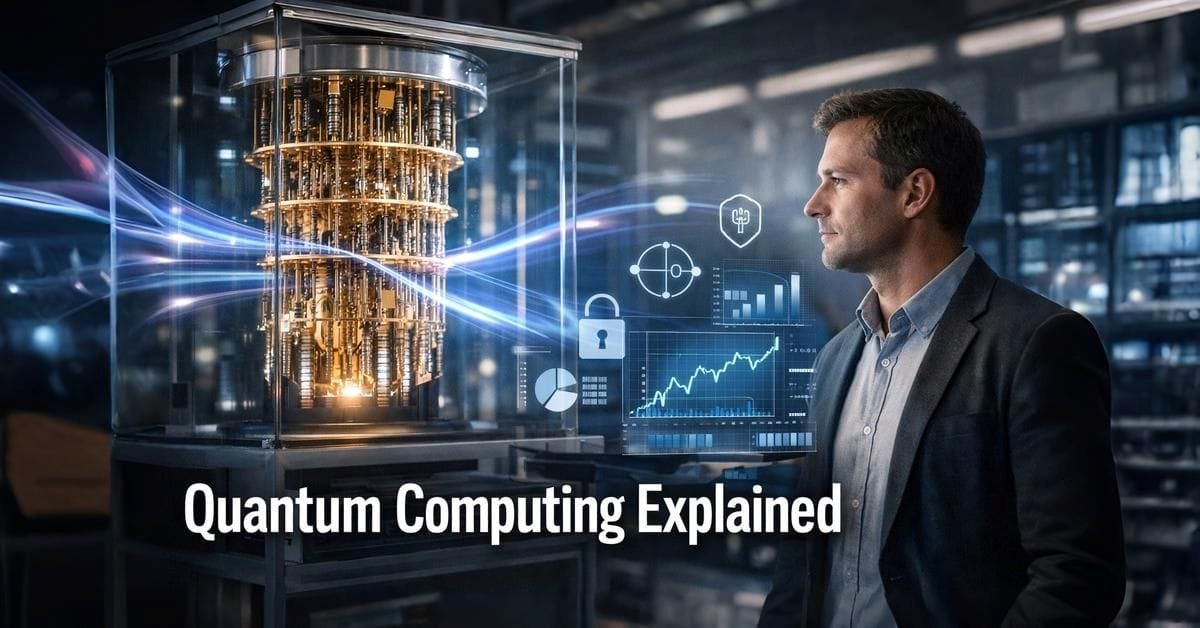
Introduction: Quantum Computing Explained
Quantum computing explained in simple terms is no longer a purely academic exercise. It has become a practical concern for insurers, financial planners, cybersecurity professionals, and institutional investors worldwide. As someone who works at the intersection of risk management and long-term financial planning, I have seen firsthand how emerging technologies quietly reshape underwriting models, data security assumptions, and investment strategies before most individuals realize what is happening.
This article explains what quantum computing is, how it works, why it matters financially, and how it may affect insurance, risk protection, and capital markets over the next decade. More importantly, it clarifies where the real risks lie—and where exaggerated fears should be ignored.
Understanding Quantum Computing at a Practical Level
What Quantum Computing Really Means
Quantum computing explained properly requires separating science fiction from financial reality. Traditional computers process information using bits that exist as either 0 or 1. A quantum computing system uses quantum bits, known as a qubit, which can exist in multiple states simultaneously.
This capability allows certain calculations to be processed exponentially faster than classical machines. However, speed alone is not the entire story. Quantum computing is about solving specific categories of problems that are currently impractical or financially prohibitive using classical infrastructure.
Why This Matters Outside of Physics Labs
From a financial and insurance perspective, the concern is not abstract physics. The concern is how rapidly complex risk modeling, cryptographic analysis, and portfolio simulations could change once quantum computing reaches commercial maturity.
For example, insurers rely on probabilistic models that currently require hours or days to compute at scale. A mature quantum system could compress those timelines dramatically, creating competitive advantages for firms that adopt early.
How Quantum Computers Actually Work
The Role of the Qubit
A qubit is fundamentally different from a classical bit. It leverages quantum properties such as superposition and entanglement. This allows quantum machines to evaluate many possible outcomes at once instead of sequentially.
From a risk-analysis standpoint, this means scenario modeling at a scale previously reserved for theoretical research. Complex catastrophe modeling, financial stress testing, and actuarial simulations could all be transformed.
Stability and Error Challenges
It is critical to understand that today’s quantum computing systems are fragile. Qubits are highly sensitive to environmental interference, which introduces errors. This limits immediate real-world deployment and is why quantum computing should be viewed as a long-term strategic risk, not an overnight disruption.
Major Companies Driving Quantum Computing Forward
IBM’s Leadership in Commercial Access
The ibm quantum computer initiative has been one of the earliest attempts to make quantum systems accessible through cloud platforms. IBM’s strategy is particularly relevant to insurers and financial institutions because it mirrors the adoption path of cloud computing a decade ago.
Rather than requiring direct ownership of expensive hardware, companies can experiment with quantum workloads while managing capital expenditure risk.
Google’s Quantum Research Direction
Google quantum computing research focuses on demonstrating quantum advantage—the point at which a quantum computer outperforms classical machines at a meaningful task. While not yet directly monetizable, Google’s involvement signals long-term strategic importance.
Other Companies in Quantum Computing
Several companies in quantum computing are emerging across hardware, software, and quantum-as-a-service models. These include startups focused on encryption, logistics optimization, and financial simulations. For investors, this ecosystem resembles the early AI sector: high risk, high uncertainty, but potentially asymmetric returns.
Quantum Computing Cost and Financial Barriers
How Expensive Is Quantum Computing?
Quantum computer cost remains a major limiting factor. Building and maintaining a quantum system requires specialized environments, including near-absolute-zero temperatures and advanced error-correction systems.
For this reason, widespread consumer adoption is unlikely in the near term. Most financial exposure will come indirectly through cloud services and enterprise partnerships.
Cost Implications for Financial Planning
From a planning standpoint, quantum computing cost should be treated as an infrastructure risk, similar to early data centers or satellite systems. Insurers and financial institutions that fail to budget for technological shifts often experience sudden underwriting or pricing disadvantages.
Implications for Insurance, Risk Protection, and Finance
Cybersecurity and Encryption Risk
One of the most discussed risks is encryption vulnerability. Many current encryption methods rely on mathematical problems that are difficult for classical computers but potentially solvable by quantum machines.
For insurers, this introduces long-tail cyber risk exposure. Policies written today may still be active when quantum decryption becomes viable, creating retroactive risk scenarios.
Portfolio Modeling and Financial Forecasting
Quantum computing explained from a financial planning angle reveals significant upside. Portfolio optimization, risk correlation analysis, and stress testing could become more accurate, benefiting pension funds, insurers, and asset managers.
However, access inequality could widen. Institutions with early quantum access may outperform competitors, increasing systemic concentration risk.
When Will Quantum Computing Become Commercially Relevant?
Realistic Timeframes
Despite sensational headlines, quantum computing is still years away from mass deployment. Most experts estimate limited commercial relevance within the next 5–10 years, with broader financial impact closer to the mid-2030s.
For risk managers, this timeline allows for structured preparation rather than reactive decisions.
Preparing Without Overreacting
Financial planners should treat quantum computing like climate risk modeling or AI adoption: incorporate it into scenario planning, monitor regulatory developments, and avoid speculative overexposure.
How Individuals and Businesses Should Respond
For Businesses and Institutions
Organizations should begin with education and pilot programs rather than large capital commitments. Monitoring developments from ibm quantum computer platforms and enterprise cloud offerings provides early insights without excessive risk.
For Individuals and Investors
Retail investors should avoid hype-driven speculation. Exposure to quantum computing should come through diversified technology funds rather than concentrated bets.
From an insurance perspective, policyholders should expect gradual changes in cyber coverage language over time as quantum risks become better understood.
Frequently Asked Questions
What is quantum computing explained in simple terms?
Quantum computing explained simply refers to computers that use quantum physics to process information in ways traditional computers cannot, allowing faster solutions to certain complex problems.
Will quantum computing replace classical computers?
No. Quantum computers are designed for specific tasks and will complement, not replace, classical systems.
How does quantum computing affect insurance risk?
It introduces new cybersecurity and modeling risks while also enabling more accurate underwriting and risk prediction.
What is the current quantum computer cost?
Quantum systems cost millions of dollars to build and maintain, which is why most access today is cloud-based.
Are companies in quantum computing profitable today?
Most are still in research or early commercialization stages. Profitability remains limited but strategically important.
Is quantum computing explained relevant to financial planning?
Yes. It affects long-term risk assumptions, cybersecurity exposure, and institutional investment strategies.
Conclusion: Quantum Computing Explained
Quantum computing explained without exaggeration reveals a technology that is neither an immediate threat nor a distant fantasy. It is a long-term structural shift with meaningful implications for insurance, financial planning, cybersecurity, and capital markets.
For professionals and informed individuals, the correct response is measured awareness. Monitor developments, understand where risk exposure may evolve, and avoid speculative extremes. Those who plan early—but conservatively—will be best positioned to benefit from the opportunities quantum computing eventually delivers.
WebsArb Homepage
- Learn more about emerging technology risks and digital strategy at
https://www.websarb.com/category/technology/
External Sources
- https://www.ibm.com/quantum
- https://quantumai.google
- https://www.nist.gov/quantum-information-science
- https://www.arbsbuy.com/
