

Introduction: A Quiet Revolution Is Already Underway
There is a revolution happening — not in the streets, not on television, and not through slogans shouted into microphones. It is happening quietly, digitally, and relentlessly inside the minds of a generation that refuses to be spoon-fed outdated narratives.
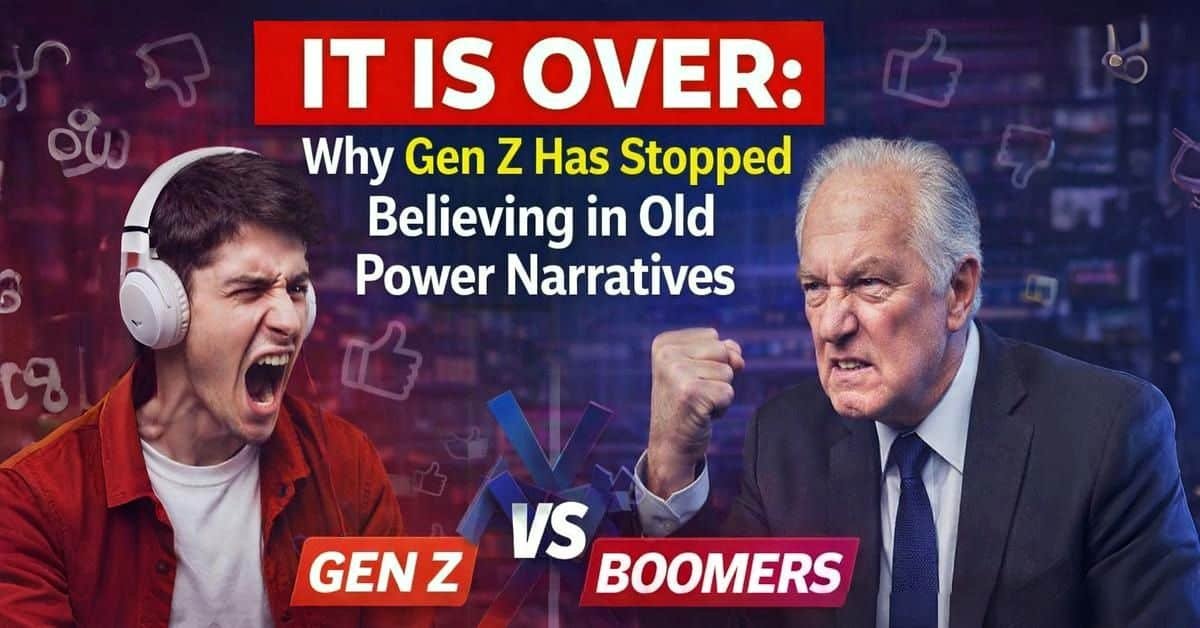
The divide between Gen Z vs Boomers is no longer theoretical. It is visible in voting patterns, migration trends, internet behavior, media consumption, and even silence. This silence is not apathy — it is awareness.
And that awareness is exactly why the old system is losing its grip.
The Myth of Forced Patriotism
Patriotism cannot be manufactured through speeches, seminars, or staged nationalism. It grows organically when people feel secure, respected, and hopeful.
Gen Z understands this intuitively.
Young people today are not rejecting their countries; they are rejecting hypocrisy. When basic needs remain unmet, when corruption goes unpunished, and when opportunity is reserved for a few, slogans lose meaning. This widening generational divide has exposed a hard truth: loyalty cannot be demanded — it must be earned.
The Internet Changed Everything
Previous generations controlled information through newspapers, television, and state-approved narratives. Gen Z grew up in a different reality.
The internet democratized truth.
Despite attempts at censorship and firewalls, young people learned how to bypass restrictions, verify facts, and hear alternative perspectives. This is why censorship and internet freedom have become such critical battlegrounds.
Trying to control information today is like trying to hold water in your hands — it slips through.
Thinking Independently Is the Real Threat
What truly unsettles old power structures is not rebellion — it’s independent thinking.
Gen Z doesn’t wait to be told what to believe. They research, cross-check, question, and satirize. Memes have replaced propaganda. Humor has replaced fear.
This new Gen Z mindset values authenticity over authority and logic over loyalty.
Silence Is Not Acceptance
Many mistake Gen Z’s quiet exit for indifference. In reality, it is strategic withdrawal.
Young professionals, freelancers, researchers, and creatives are leaving — physically or mentally. Brain drain is not accidental; it is a consequence of ignored voices.
This shift reflects deep economic inequality. Rising rents, unaffordable education, stagnant wages, and limited mobility have forced young people to choose survival over sentiment.
The Collapse of Mainstream Media
Television once shaped public opinion. Today, it struggles to hold attention.
Gen Z consumes information on their own terms — podcasts, independent journalism, long-form YouTube analysis, and community-driven platforms. The decline of mainstream media is not accidental; it failed to evolve.
When media loses credibility, it loses relevance.
Why Regulation Backfires
Efforts to over-regulate freelancing, digital platforms, and online work are deeply out of touch with how the modern economy functions.
Gen Z thrives in decentralized systems. They build careers without offices, borders, or permission. Attempts to control this ecosystem only accelerate disengagement.
This is a critical point in the ongoing Gen Z vs Boomers conflict: one side adapts; the other resists.
Power Without Trust Is Empty
Unchecked authority may enforce obedience, but it cannot inspire belief.
When leaders require layers of security to face the public, it signals a breakdown of trust. True legitimacy doesn’t fear questions — it welcomes them.
This erosion of trust is central to today’s youth political awareness. Young people may not always protest loudly, but they remember everything.
The Point of No Return
The most dangerous misconception is assuming this phase will pass.
It won’t.
Gen Z is not waiting to “grow out of” skepticism. This skepticism was shaped by lived experience — financial instability, restricted freedoms, and global exposure.
They are not anti-system; they are anti-illusion.
Conclusion: The Narrative Has Expired
The old narrative depended on silence, fear, and controlled information. None of those tools work anymore. Gen Z has headphones on, access to the world, and options beyond borders. If ignored, they leave. If provoked, they create culture — loudly. One way or another, the message is clear:
The story you’re selling is worn out. And no one is buying it anymore.
About the Author
Zorain Nizamani is a writer and researcher pursuing a PhD in Criminology at the University of Arkansas at Little Rock. His work focuses on power structures, generational change, and social behavior in the digital age. You can learn more about his work on his official website:
https://tribune.com.pk/story/2583524/no-more-boomers
